

More about Bicycle Wheel
- All
- Info
- Video
- Shop




Contributor
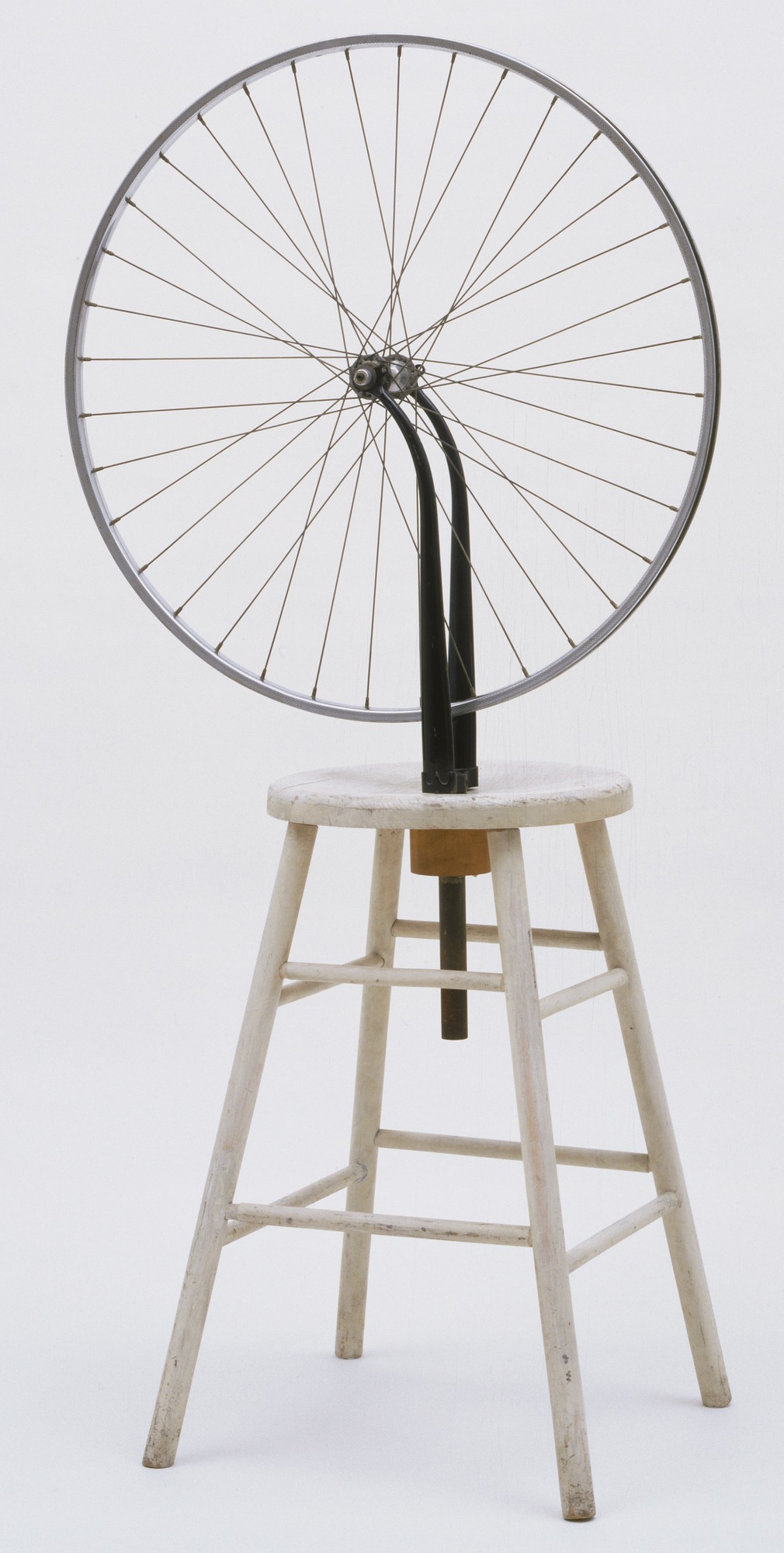
Marcel Duchamp’s Bicycle Wheel (1913, replica 1951) “...was the first version of the thing that would become the readymades.”
At their core, the readymades were mass-produced objects selected by Duchamp, who then declared them to be art. Prior to the readymades, art generally strove to be a beautiful, handmade object. In contrast to this idea, Duchamp stated that the object’s choice was based on visual indifference, “...with at the same time a total absence of good or bad taste.” This rejection of taste and beauty positioned Duchamp’s readymades as “anti-art.”
However, the origins of Bicycle Wheel (1913) run contrary to Duchamp’s professed disaffection. When Duchamp invented the readymade with Bicycle Wheel (1913,) he focused on the pleasure the object gave him. It was, “...something to have in my room the way you have a fire or pencil sharpener, except that there was no usefulness. It was a pleasant gadget, pleasant for the movement it gave.” This sense of pleasure derived from the work is contrary to the aesthetic void that he would later describe as the basis for the idea of the readymade to in interviews.
Bicycle Wheel has been remade several times because it keeps getting lost. Both the 1913 and 1916 versions have disappeared. The 1951 replica is still extant, however.
There are slight differences in the design of Bicycle Wheel (1916) and Bicycle Wheel (1951). In a 1916 photograph from Duchamp’s New York studio, the 1916 iteration of the wheel appears to be either from a straight-forked unicycle or a bicycle nicknamed the “Bone Shaker.” If the latter, this type of bicycle was produced between 1863-1878. It was gradually phased out of production for the curved form of the “safety bicycle.” In contrast to the 1913 version, the Bicycle Wheel (1951) spins on a modernized curved fork.
Paradoxically, Duchamp may have considered all versions of Bicycle Wheel (1913-1951) as the same piece. Since the objects were mass-produced, Duchamp didn’t consider any of his readymades as “originals.” Following this thought, Bicycle Wheel (1951) is the same piece as Bicycle Wheel (1916) and Bicycle Wheel (1913.) This logic is a bit much to wrap one’s head around. However, it is a puzzle for the viewer that would have undoubtedly delighted the mischievous artist.
Duchamp reinvented the wheel with his fork affixed to a stool. This work was the first in a line of his pieces that redefined art as an act of the mind. His work went on to influence artists such as Jasper Johns, Robert Rauschenberg, and Joseph Kosuth. It is also perhaps one of the most notorious ideas in contemporary art. It gave way for the likes of Damien Hirst to declare his dead shark art and rake in millions at auction.
Whether good, bad, or indifferent to him, Duchamp’s readymade idea began with Bicycle Wheel in 1913 and crafted a legacy that changed the course of art history.
Sources
Sources
- Allen, John S. “Reply to Kline’s response to “Straight Forks and Pneumatic Tires: Historicizing Duchamp’s Bicycle Wheel of (1913.)” Tout Fait. https://www.toutfait.com/reply-to-klines-response-to-straight-forks-and…
- “Audio about Bicycle Wheel.” MoMA. Date accessed 4/25/2019. https://www.moma.org/collection/works/81631?sov_referrer=art_term&art_t….
- Baudrillard, Jean. Simulacra and Simulation. 1981
- “Bicycle Wheel.” MoMA Learning. https://www.moma.org/learn/moma_learning/marcel-duchamp-bicycle-wheel-n…. Date accessed: 4/28/2019.
- Blunck, Lars tr. Jan Wagner. “ Between Gadget and Re-made: The Revolving History of the Bicycle Wheel.” https://www.toutfait.com/between-gadget-and-re-made-the-revolving-histo…
- Duchamp, Marcel. “Apropos of Readymades (1961).” Theories and Documents of Contemporary Art: A Sourcebook of Artists’ Writings ed. Kristine Stiles and Peter Selz. London: University of California Press, 1996.
- Duchamp, Marcel ed. Michel Sanouillet and Elmer Peterson. The Essential Writings of Marcel Duchamp: Salt Seller/Marchand du Sel. London: Thames and Hudson, 1975.
- Duchamp, Marcel. “The Richard Mutt Case.” The Blind Man, issue 2. http://sdrc.lib.uiowa.edu/dada/blindman/2/05.htm. Date accessed 4/28/2019.
- “God.” The Metropolitan Museum of Art. https://www.metmuseum.org/art/collection/search/261000. Date accessed: 4/29/19.
- Gammel, Irene. BARONESS ELSA Gender, Dada, and Everyday Modernity: A Cultural Biography. Cambridge, Mass.: The MIT Press. *Cotter presents strong evidence that the Baroness authored Fountain.
- Housefield, James. Playing with Earth and Sky: Astronomy, Geography, and the Art of Marcel Duchamp. Hanover, New Hampshire: Dartmouth College Press, 2016.
- “Important Art by Baroness Elsa Freytag-von Loringhoven.” The Artstory. https://www.theartstory.org/artist-von-freytag-loringhoven-elsa-artwork…. Date accessed, 4/25/2019, 11:07 AM.
- “Marcel Duchamp, Bicycle Wheel.” MoMA. Date accessed 4/25/2019. https://www.moma.org/collection/works/81631?sov_referrer=art_term&art_t….
- “Readymade.” MoMA. Date accessed, 4/25/2019. https://www.moma.org/collection/terms/88
- Shearer, Rhonda Roland. “WHY IS MARCEL DUCHAMP’S BICYCLE WHEEL SHAKING ON ITS STOOL?” Art and Science Research Laboratory. https://asrlab.org/pressreprints/why-is-marcel-duchamps-bicycle-wheel-s….
- Yang, Shin-Yi. “Straight Forks and Pneumatic Tires: Historicizing Duchamp’s Bicycle Wheel of (1913.)” Tout Fait. https://www.toutfait.com/straight-forks-and-pneumatic-tireshistoricizin…
- Yang, Shin-Yi. Response to “What Makes the Bicycle Wheel a Readymade?” 5/1/2000. Date accessed, 4/23/19. https://www.toutfait.com/straight-forks-and-pneumatic-tireshistoricizin…. 4/1/2003. Date accessed 4/23/19.
- Tomkins, Calvin. Marcel Duchamp: A Biography. New York: Owl Book, 1996.
- “With Hidden Noise.” Philadelphia Museum of Art. https://www.philamuseum.org/collections/permanent/51541.html. Date accessed, 4/25/2019, 6:49 PM.
- “The Mama of Dada.” The New York Times. https://www.nytimes.com/2002/05/19/books/the-mama-of-dada.html. May 19, 2002. Date accessed: 4/28/2019. Baroness Elsa moved to New York in 1909, was in Germany prior to that.
- “Anti Art.” Tate. https://www.tate.org.uk/art/art-terms/a/anti-art. Date accessed, 4/28/2019.
- “Readymade.” Tate. https://www.tate.org.uk/art/art-terms/r/readymade. Date accessed, 4/28/2019. The readymade was the beginning of conceptual art. A shift for art from handcraft to the artist’s choice.

Featured Content
Here is what Wikipedia says about Bicycle Wheel
Bicycle Wheel is an early readymade created by French artist Marcel Duchamp in 1913. Consisting of a bicycle wheel mounted upside down on a wooden stool, it is often considered one of the earliest examples of kinetic sculpture. Although later categorized as a readymade, Bicycle Wheel was not originally intended as an artwork.
Check out the full Wikipedia article about Bicycle Wheel