

More about Fountain
- All
- Info
- Video
- Shop


Contributor
Though Marcel Duchamp's original Fountain has been lost in the sands of time, the iconic urinal still begs a question for all ages:
“But…who says its art?”
To which Duchamp replies: “Bitch, I do. “
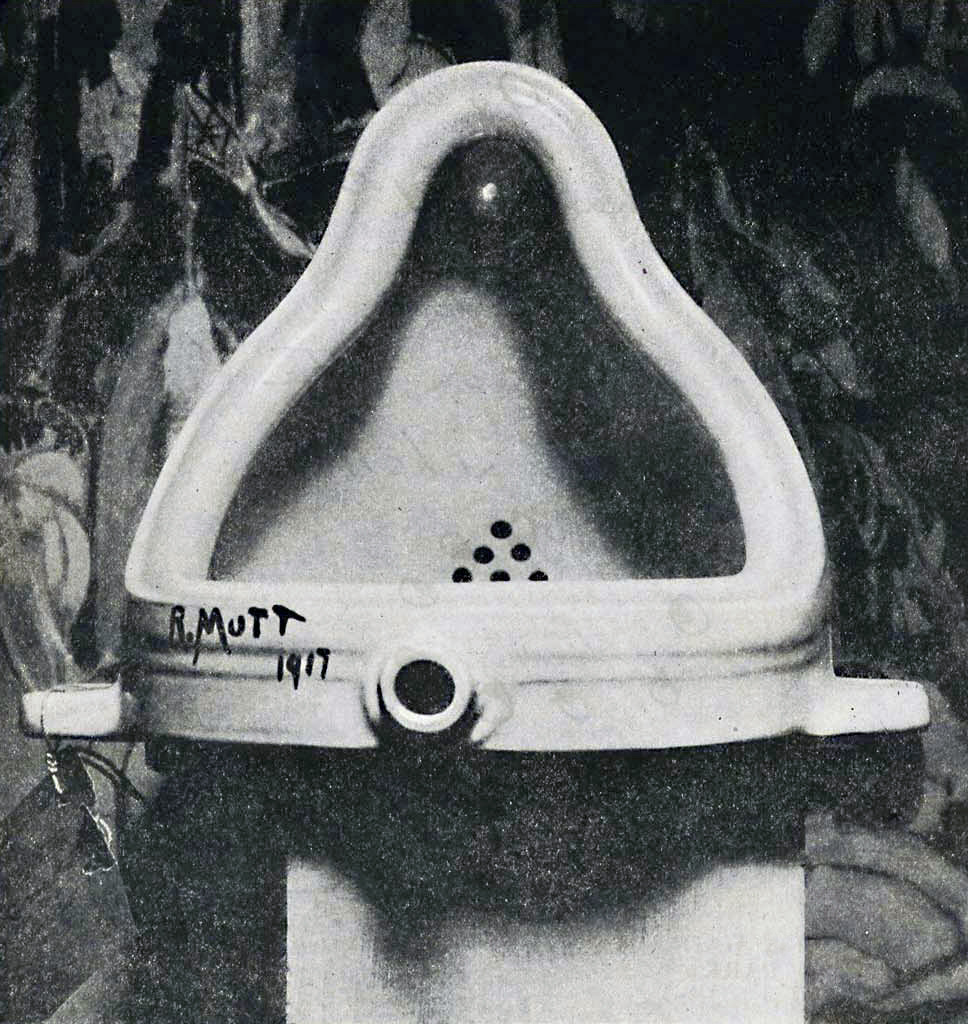
And that's evident by the thing's legacy. We are now left with numerous replicas of the porcelain piss pot. The signature on all these outrageous "sculptures" reads R. Mutt, a phrase that has become susceptible to various meanings.
- Some have concluded that it is a clever take on the name of this particular urinals manufacturer (Mott Plumbing).
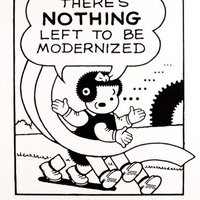
- Others say it's a reference to the Mutt and Jeff comic strip that was popular at the time.
- There are also those who surmise that the title sounds a bit like the German word Armut which means poverty, or Urmutter which is German for great mother. This last stab at evaluation is my own personal favorite because the urinal also resembles an upside-down womb of sorts- Urmutter, indeed!
Avant-garde to the extreme, Duchamp submitted this, now most famous of his readymades, for an exhibition in 1917, but the committee dumped the work. Why? It’s a urinal, for Pete’s sake! How does that qualify as art??
In defense of Duchamp, here’s his own statement about the work published in 1917: “Whether Mr. Mutt with his own hands made the fountain or not has no importance. He CHOSE it. He took an ordinary article of life, placed it so that its useful significance disappeared under the new title and point of view—created a new thought for that object.”
Difficult to argue with that thought now. Clearly, a lot of people saw eye to eye eventually, because Fountain came to be voted the most influential artwork of the 20th century in 2004 by art world bigwigs. But more there have also been several occasions on which less reverent bladders have been emptied into this particular urinal. Some which qualify as performance art...and maybe others just really had to pee.
And if you're into the whole urine fetish, check out Andy Warhol's Oxidation paintings. Or go one step further (number 1 to number 2!) with Piero Manzoni's Merda d'Artisa, or "Artist's Shit".

Featured Content
Here is what Wikipedia says about Fountain (Duchamp)

Fountain was a readymade sculpture attributed to Marcel Duchamp in 1917, consisting of a porcelain urinal signed "R. Mutt". The work is regarded by art historians and theorists of the avant-garde as a major landmark in 20th-century art.
In April 1917, an ordinary piece of plumbing was submitted for the inaugural exhibition of the Society of Independent Artists, to be staged at the Grand Central Palace in New York. When explaining the purpose of his readymade sculpture, Duchamp stated they are "everyday objects raised to the dignity of a work of art by the artist's act of choice." In Duchamp's presentation, the urinal's orientation was altered from its usual positioning. Fountain was not rejected by the committee, since Society rules stated that all works would be accepted from artists who paid the fee, but the work was never placed in the show area. Following that removal, Fountain was photographed at Alfred Stieglitz's studio, and the photo published in the Dada journal The Blind Man. The original has been lost. Sixteen replicas were commissioned from Duchamp in the 1950s and 1960s and made to his approval.
In recent years it has been proposed that the original work was by the female artist Elsa von Freytag-Loringhoven who submitted it to Duchamp as a friend. New research from Glyn Thompson, a former professor of art history at the University of Leeds, identifies the handwriting scrawled on the urinal as belonging to Von Freytag-Loringhoven, who was living and working in Philadelphia when the urinal was submitted to the exhibition in 1917. He also labels the urinal as a unique model made by a plumbing shop in Philadelphia—a city Duchamp never visited.
Fountain is included in the Marcel Duchamp catalogue raisonné by Arturo Schwarz; The complete works of Marcel Duchamp (number 345).
Check out the full Wikipedia article about Fountain (Duchamp)