More about Victoria and Albert Museum
Contributor
Victoria married her first cousin Albert.
Their museum claims to have the worlds largest collection of artworks (over 4.5 million).

Sr. Editor
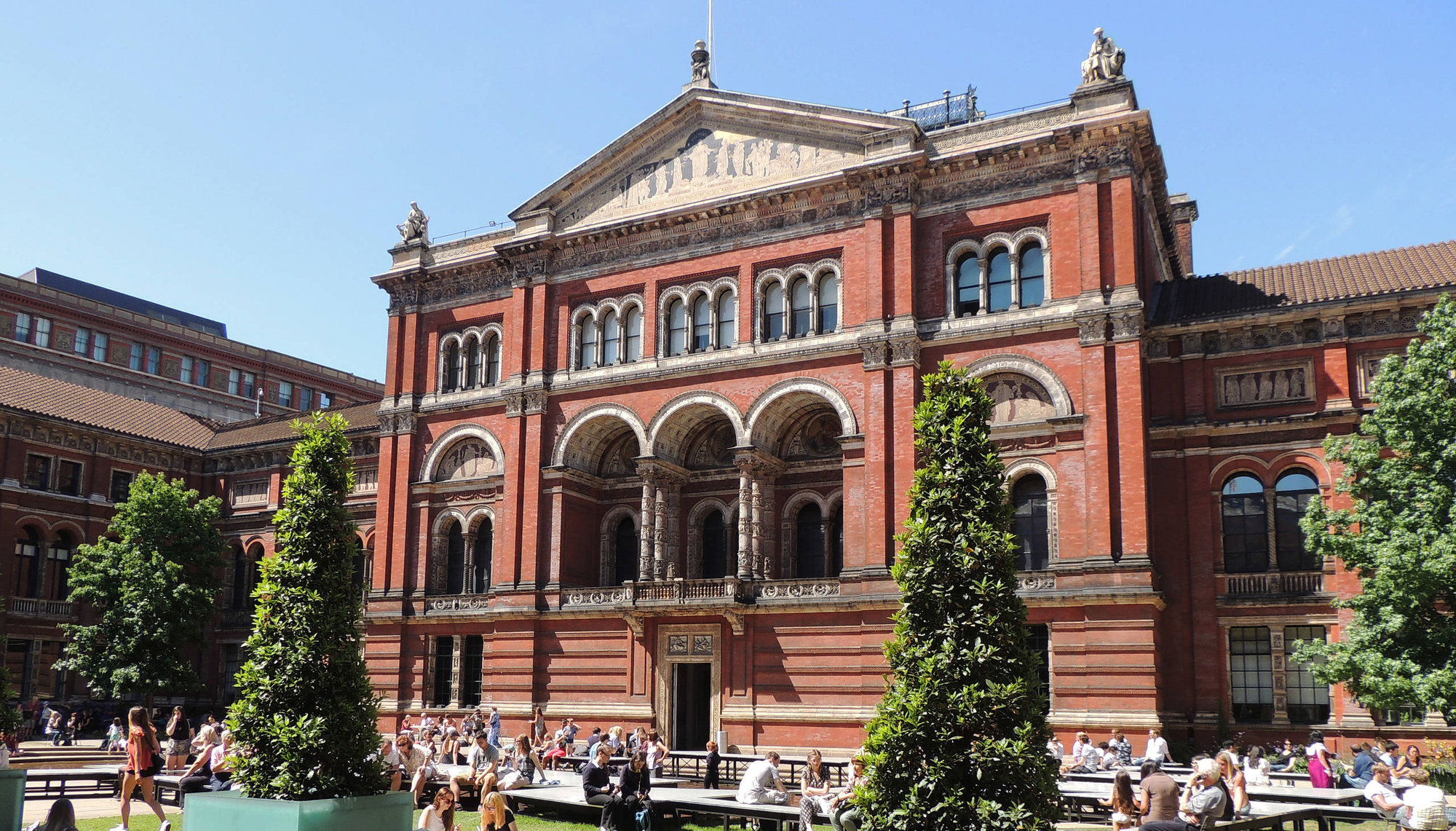
The Victoria and Albert Museum is in a part of town more exclusive than 90210 and neighbors with the Natural History Museum, Science Museum, French Consulate, and Kensington Gardens.
Sometimes referred to as Albertopolis due to the large number of projects Prince Albert supported in the area.
In a silly conspiracy theory that doesn't exist because I just made it up, something fit for a Dan Brown novel; a straight line can be drawn from the Albert Memorial in Kensington Gardens, between the Royal Albert Hall and Royal College of Music, to the Queen’s Tower of Imperial College London, and ending at the rear of the Science Museum. The points can only be seen from the Queen’s Tower, which is rarely open to visitors and requires an ascent of 325 steps. In Dan Brown’s hypothetical novel this would no doubt represent some sort of spiritual journey ending in a Jesus related revelation about the mysticism of life.
I mainly wanted to come here to see pretty dresses. I thought the halls would be lined with recognizable gowns from my favorite movies and fashion designers. Unfortunately, that kind of ostentatious display is reserved for those special exhibitions you have to pay for. In the free area they have a very lovely display of the history of fashion, though only one or two dresses I would consider worthy of a Thomas Crown style heist for my dream closet. There's a ton to see and if you don't take regular breaks you may just drop dead. The upper floors seem to have more benches per room to prevent an untimely demise. I can neither confirm nor deny that I had a quick nap in the glass room on the fourth floor. Also, snacks. Bring lots of quiet snacks you can hide from the guards.
Some historical nuggets:
- Sir Henry Cole, the inventor of the Christmas card, was the greatest supporter of developing the museum and became its first director. One of Cole’s first Christmas Cards sold in 2001 for £22,500.
- In 1893, the museum collection was officially split to divide the science and art collections thus creating the new Science Museum.
- Queen Victoria made her last official public appearance when she laid the foundation stone for the Science Museum in 1899 and it was announced that the art museum’s name would be changed from the South Kensington Museum to the Victoria and Albert Museum.
- During World War I, an unused tunnel that connected part of the South Kensington tube and the museum was used by the V&A to store art and by Buckingham Palace to store china.
- During World War II, collections were sent to quarries and houses in the country and some went to the nearby defunct Aldwych tube station. Galleries were used as classrooms and later a canteen for soldiers.
Featured Content
Here is what Wikipedia says about Victoria and Albert Museum
The Victoria and Albert Museum (abbreviated V&A) in the United Kingdom is the world's largest museum of applied arts, decorative arts and design, housing a permanent collection of over 2.8 million objects.
The Victoria and Albert Museum collection is housed across six sites in the United Kingdom. This "family of museums" comprises;-
- V&A South Kensington, the museum's original London site which covers 12.5 acres (5.1 ha) in the Royal Borough of Kensington and Chelsea in London and has over 145 galleries.
- Young V&A, opened as the V&A Bethnal Green Museum in 1872, became the Museum of Childhood in 1974 and then the Young V&A in 2023.
- V&A Dundee, opened in September 2018
- V&A Wedgwood Collection, the former Wedgwood Museum in Barlaston, Stoke-on-Trent acquired in 2014
- V&A East Storehouse, opened in June 2025
- V&A East Museum, opened in April 2026.
The sites share a common website which also hosts the "Order an Object" service allowing members of the public to view individual objects at V&A East Storehouse or at South Kensington.
The museum collection spans 5,000 years, from ancient history to the present day, and includes works from Europe, the Americas, Africa and Asia plus art from South Asia, China, Japan, Korea and the Islamic world. The East Asian collections are particularly strong in ceramics and metalwork, while the Islamic collection is amongst the largest in the Western world. The museum also holds one of the largest collections of post-classical sculpture in the world. Its collection of Italian Renaissance sculpture being the largest outside Italy, however, the art of antiquity in most areas is not the V&A's focus. The holdings of ceramics, glass, textiles, costumes, jewellery, silver, metalwork, furniture, medieval objects, sculpture, prints, drawings and photographs are also among the largest and most comprehensive in the world.
The museum can trace its origins to the Government School of Design, established in 1832, and until 1983, the museum remained directly controlled by a government department, initially the Board of Education and eventually the Department of Education and Science. It is now a non-departmental public body sponsored by the Department for Culture, Media and Sport. As with other national British museums, entrance is free.
Overall, the V&A is one of the world's largest museums.
Check out the full Wikipedia article about Victoria and Albert Museum