More about Paris Street; Rainy Day
- All
- Info
- Shop

Contributor
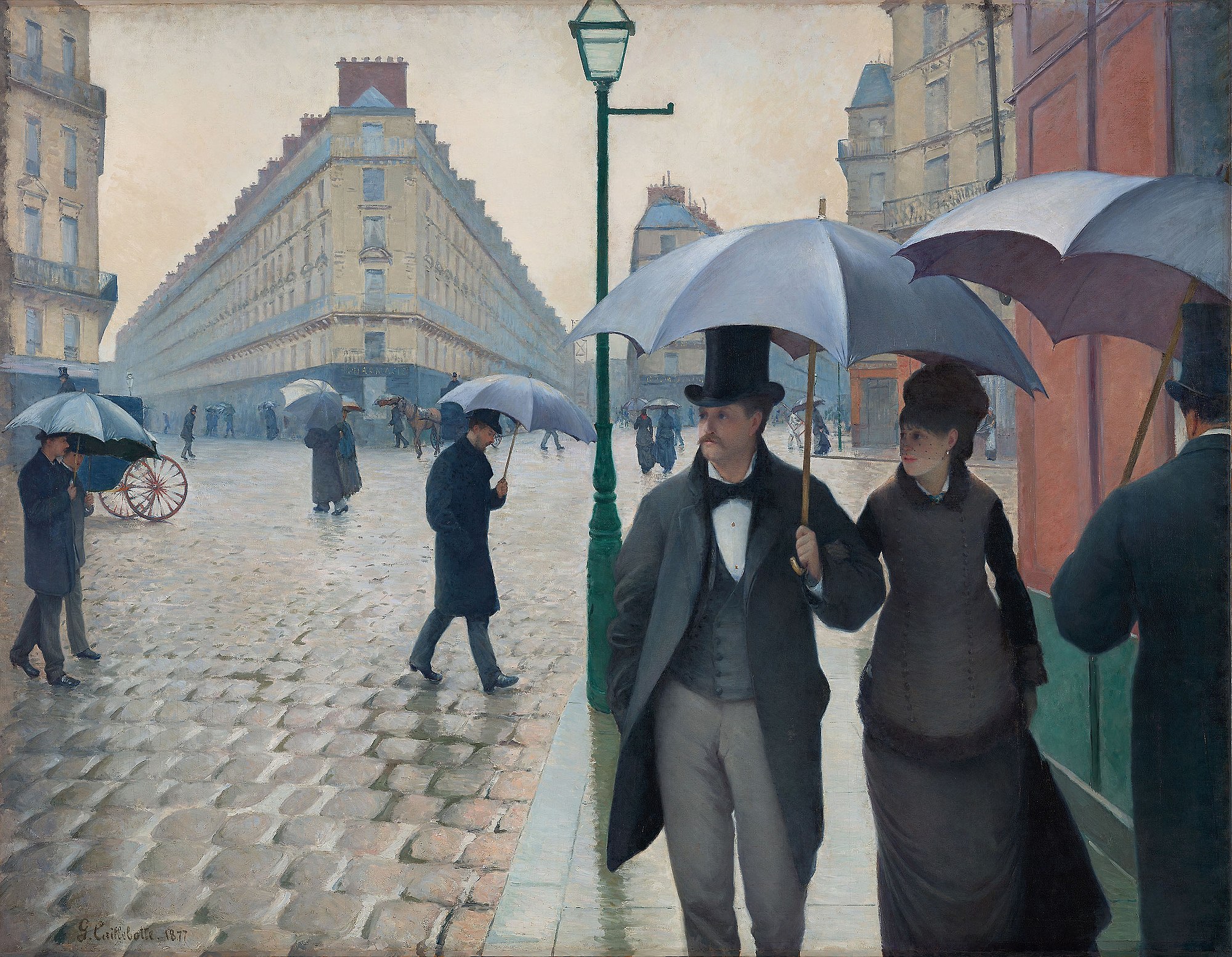
At the age of 29 when this piece debuted, Caillebotte was the youngin' of the Impressionist scene.
He worshipped artists such as Monet and Manet and bought and collected a lot of their works, to the point that when he died and donated his collection to the French nation, it later made up most of what is now the Musée d’Orsay.
Upon closer observation however, you may say that this painting doesn’t look Impressionist at all. And you would be right. This painting is a lot more finished than the quick, sketch-like paintings of the classic Impressionist movement. You can see the inspiration from photography in this work with the cropping and the focus in the forefront, lack of focus in the background. It also has that snapshot, live-in-the-moment vibe with the people mid-step and looking off in the distance. However, it does align with Impressionist style in terms of subject and his focus on light. Honestly, Caillebotte could do whatever he wanted because he basically kept the movement alive with his patronage.
The street depicted here is still around. It’s the intersection near Saint-Lazare train station, for those of you who are familiar with Parisian geography. It was a new street at the time that this painting was created. Baron Haussmann (who wasn’t actually a baron but had delusions of grandeur and a knack for city planning so people just went along with it) started remodeling Paris, getting it ready for the onslaught of capitalism that was upon them. This painting is a representation of the new Paris, where you could roam the newly lit streets and hire all the prostitutes your heart desired. Vive la France!

Featured Content
Here is what Wikipedia says about Paris Street; Rainy Day
Paris Street; Rainy Day (French: Rue de Paris, temps de pluie) is a large 1877 oil painting by the French artist Gustave Caillebotte, now at the Art Institute of Chicago in Chicago, Illinois. The work shows a Parisian street scene of pedestrians in rainy weather crossing a boulevard intersection in the present-day Place de Dublin, a square in the eighth arrondissement. It is the best known of Caillebotte's several cityscapes linked to Paris's reconstruction under Napoleon III and Georges-Eugène Haussmann in the mid-19th century. Paris Street exemplifies the artist's views on modernity.
Caillebotte made a number of preliminary sketches in graphite and oil. The composition shows 24 mostly bourgeois pedestrians, dominated by a foreground couple with an umbrella, who are staring outside of the viewer's field of vision. The painting takes the form of a photorealistic cityscape, departing from the typical style of Impressionist art, representative of a Paris that appears austere and hostile to human interaction. Caillebotte employed several visual techniques to create the illusion of three-dimensional space, such as linear two-point perspective and colour effects.
Paris Street was first shown in April 1877 at the Third Impressionist Exhibition in Paris, where it was widely praised for its photorealism and precision. It was not displayed publicly again until a posthumous retrospective exhibition in 1894. Caillebotte bequeathed the work to his youngest brother Martial, and it remained in obscurity, in the family's possession, before being sold to art collectors in the mid-20th century. The Art Institute of Chicago's acquisition in 1964 accelerated a revival of Caillebotte's art, increasing his reputation as an artist in the public eye.
Check out the full Wikipedia article about Paris Street; Rainy Day








It's understandable why this piece would be Caillebotte's most popular work. He seems to mix to styles together, Realism and Impressionism. The subject and the lighting all point to Impressionism and because the details aren't quite as clear as a realist would paint them. But Realism comes into play because it's still more detailed than an impressionist painting and captures people in action. Not to mention that Caillebotte's painting is similar to a photograph, focusing on the closest subjects, the couple walking down the sidewalk, and blurring the background. Including a figure that's halfway out of the painting also gives it the feeling of a photo. This is due to the fact that Caillebotte's brother was into photography and it inspired Caillebotte. Caillebotte's first real mentor in his painting career, Leon Bonnat, was a realistic painter which is why Caillebotte probably held on to some realistic features. Another interesting aspect of his painting is his use of space and perspective. Including a triangular building splits the perspective in two and it feels like the viewer is walking on the street, and could go in either direction. Caillebotte used a lot of interesting perspectives in his paintings of Paris and would always give the viewer the feeling of being right there with the subject of the painting.