

More about Lady with an Ermine
- All
- Info
- Shop


Sr. Editor
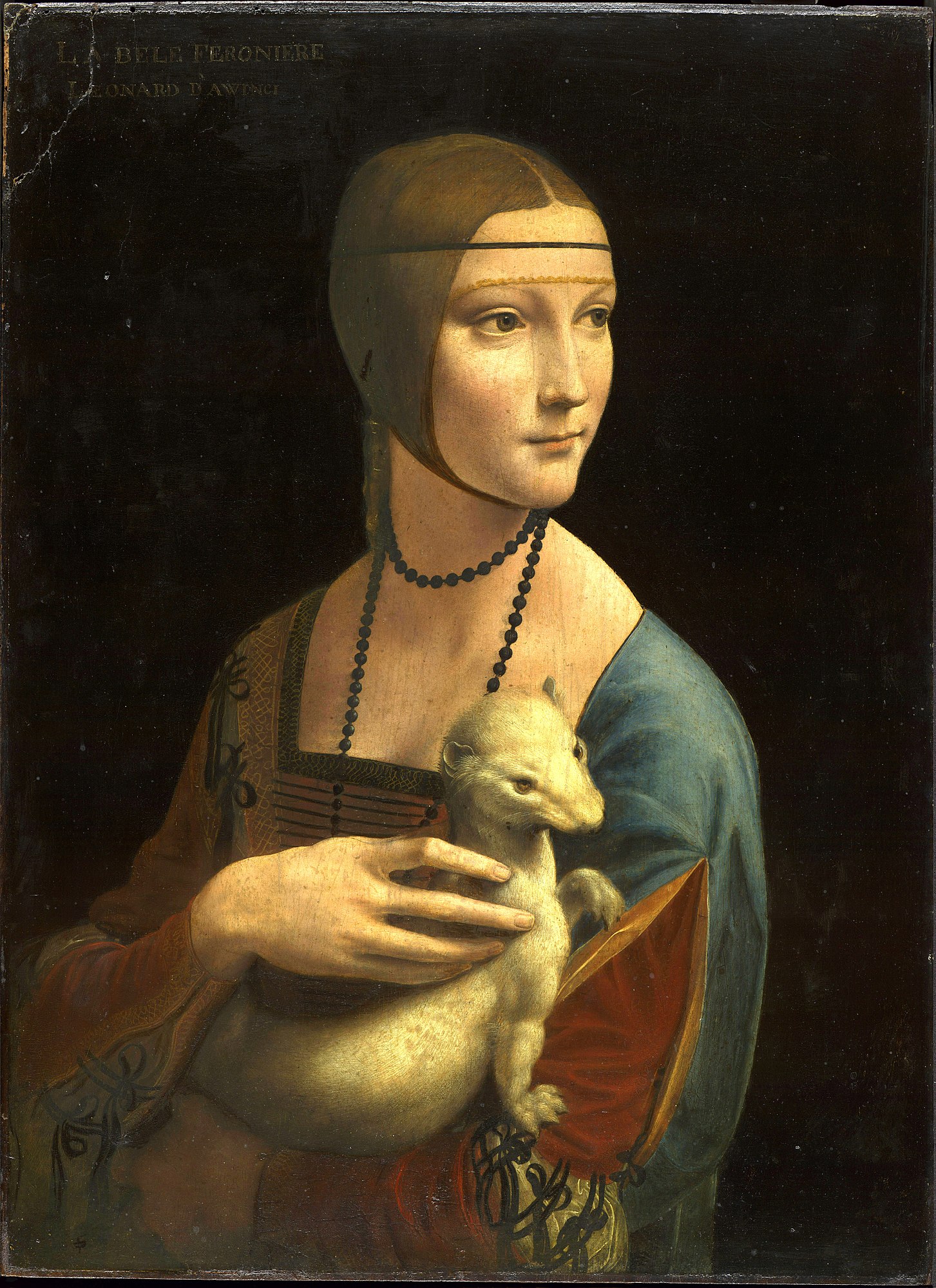
Leonardo da Vinci becomes besties with the Duke of Milan's mistress. Doesn't get in trouble with the wife.
This is a portrait of 15 or 16-year-old Cecilia Gallerani, mistress of Ludovico Sforza, duke of Milan. The Duke commissioned this piece while Leonardo was employed in his court. He also commissioned The Last Supper fresco several years later.
Cecilia had a lot going for her. She was blessed with beauty and brains with a special knack for poetry and music. Cecilia presided over intellectual gatherings and would invite Leonardo along!
In 1491 the Duke married Beatrice d’Este AND welcomed the birth of his son with Cecilia. Leonardo served as wedding planner. Beatrice was apparently not aware of Cecilia until this point and had the Duke remove her from court. The Duke sent her to live in the Verme Palace outside of Milan until she married her husband Count Ludovico Carminati de’ Brambilla and had four kids with him.
The ermine is based off of Leonardo’s drawings of a bear head and dog paw. For some reason nobody would loan him one of their ermines. There are several theories about the purpose of the ermine:
- It’s a symbol of purity because ermines are stupid and would rather be captured than hide in a dirty hole that would ruin its beautiful fur.
- It’s a fancy pet that members of court would keep…and then use as fur lining.
- The Duke was awarded the Order of the Ermine in 1488 and he used it as a personal symbol.
- Cecilia’s name sort of sounds like ermine in Greek
- Ermines are supposed to protect pregnant women alluding to the fact that Cecilia is already pregnant here.
None of this really explains Cecilia’s giant man-hands.
During one of its restorations in the late 1800’s it is speculated that Eugéne Delacroix was the one who painted over the original bluish-grey background.
This painting has done quite a bit of traveling. Cecilia took it with her when Beatrice kicked her out of the palace. It sort of disappeared until the Czartoryski Family purchased it in 1798 in Italy. They hid it from the Russian army in 1830 at the Hôtel Lambert in Paris before sending it back to Krakow in 1882. The Nazis took it in 1939 and sent it to Berlin. Hans Frank, war criminal and all around horrible Governor General of Poland, requested the painting for his office in Krakow in 1940. Allied troops found the painting at Frank’s home in Bavaria and returned it to Poland at the end of the war. When it was found by Allied troops there was a rather distinct boot print on the front that had been left by German troops.
Perhaps inspired by all this intrigue, the Polish film Vinci (2004) featured a heist centered on this painting.

Featured Content
Here is what Wikipedia says about Lady with an Ermine
The Lady with an Ermine is a portrait painting by the Italian Renaissance artist Leonardo da Vinci. Dated to c. 1489–1491, the work is painted in oils on a panel of walnut wood. Its subject is Cecilia Gallerani, a mistress of Ludovico Sforza ("Il Moro"), Duke of Milan; Leonardo was painter to the Sforza court in Milan at the time of its execution. It is the second of only four surviving portraits of women painted by Leonardo, the others being Ginevra de' Benci, La Belle Ferronnière and the Mona Lisa.
The sitter is depicted at half-length, her body turned toward her right at a three-quarter angle and her face toward her left; the animal in her arms twists in a similar manner. As in many of Leonardo's paintings, the composition forms a pyramidal spiral, reflecting his lifelong preoccupation with the dynamics of movement. The painting was long considered badly damaged and repainted. A 1992 technical analysis at the National Gallery of Art in Washington, D.C. established that the damage was largely confined to the background, which was likely originally bluish-grey and was later overpainted in black. It had always been known that Leonardo painted a portrait of Cecilia Gallerani. However, the Lady with an Ermine remained largely unknown to scholars until nearly the 20th century, and only then was it widely accepted as his work.
Prince Adam Jerzy Czartoryski acquired the painting in Italy in 1798, and it entered the Czartoryski family collections at Puławy in 1800. It travelled widely during the 19th century, including to the family's place of exile at the Hôtel Lambert in Paris, before being brought to Kraków in 1876. The Nazis seized it in 1939, and it hung in the Wawel Castle offices of Hans Frank, Governor-General of occupied Poland. Allied troops recovered it at Frank's country home in Bavaria at the end of the Second World War, and it was returned to Poland in 1946, where it remained on display in Kraków. In 2016 the Princes Czartoryski Foundation, which legally owned the painting, sold it to the Polish government, together with other works from the collection, for €100 million. Lady with an Ermine is on permanent display at the Czartoryski Museum in Kraków, a branch of the National Museum in Kraków, and is considered one of Poland's national treasures.
Check out the full Wikipedia article about Lady with an Ermine