

More about Daniel in the Lions' Den
- All
- Info
- Shop

Contributor
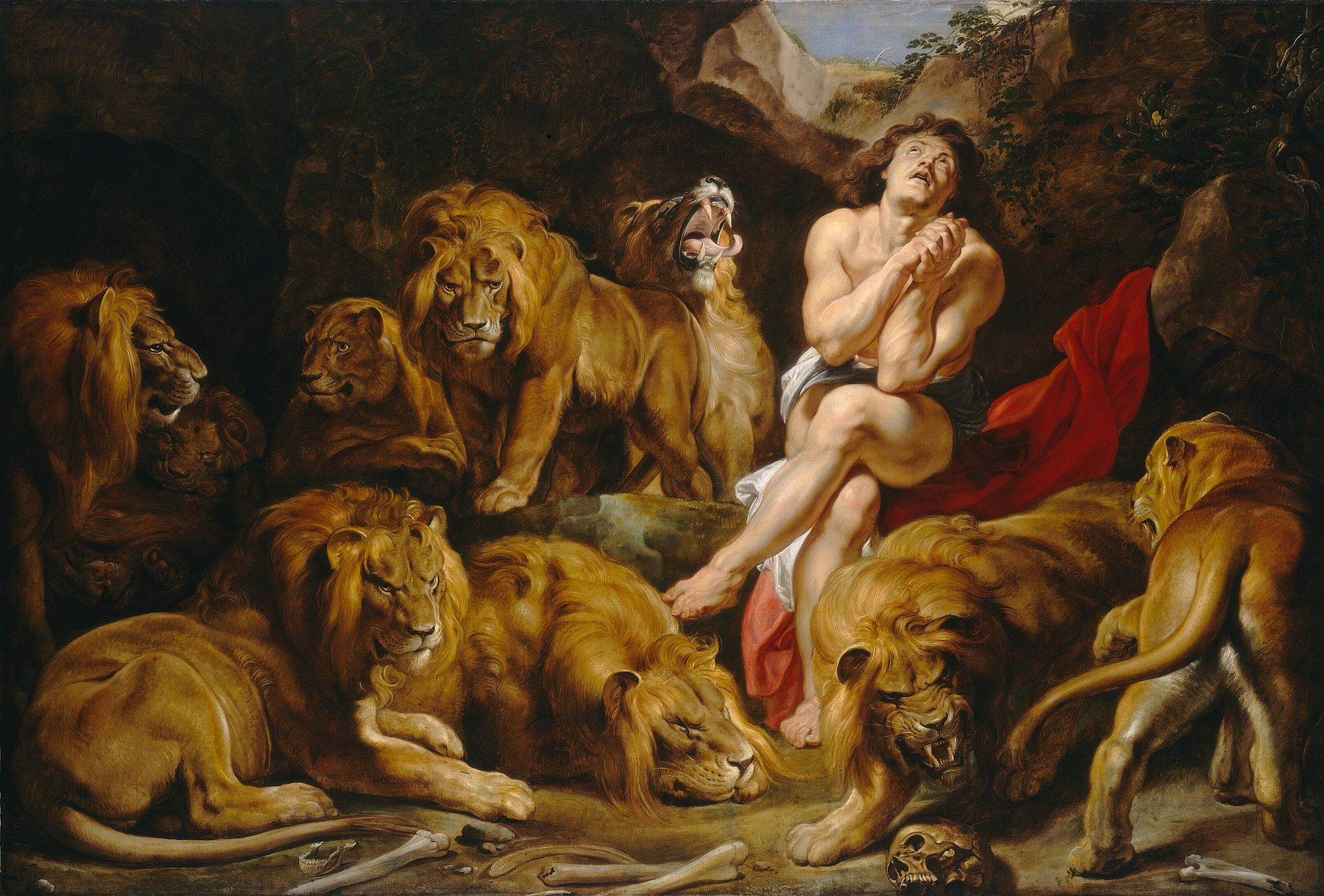
Daniel in the Lion’s Den by Peter Paul Rubens depicts some real creative talent in the art of torture and murder.
The first question one asks when encountering this painting is “y tho?” And the answer to that very astute question is because Daniel was the favorite of King Darius I and all of the other noblemen were jealous. So they secretly passed a law stating that no one is allowed to worship anyone but the king, knowing how much Daniel loved Jesus. After finding out that Daniel still prayed to God and not him, the king was forced to make an example out of Daniel. So he threw him in into the lion’s den because there was definitely no other options in this situation.
Daniel spent a rather anxious night there, as you can see through his facial expression. He’s trying to make his body small by crossing his legs and holding his arms close to him while still praying, obviously. Meanwhile the lions, ten in all, are circling around him in an about-to-eat-you kind of way. There are human skulls and other miscellaneous bones on the ground suggesting that these lions are not exactly vegetarian. What this painting doesn’t show is what the king and his men found in the morning…
It was a perfectly fine Daniel! Minus the few years taken off of his life due to stress. They were all shocked that he wasn’t dead and asked how he survived. Daniel stated, “O king, live for ever. My God hath sent his angel, and hath shut the lions' mouths, that they have not hurt me: forasmuch as before him innocency was found in me; and also before thee, O king, have I done no hurt." (Daniel 6:21–22) This was a huge relief to Darius because he never really wanted to throw his friend into a lion’s den. It was more of a power thing than a friendship thing. The moral of the story, if you haven’t figured it out, is that if you are loyal to God, he will protect you from harm, death or lions.
Sources
Sources
- "Daniel In The Lions' Den." Nga.gov. Web. 12 Feb. 2018.
- Richard, Paul. "Daniel In The Lion's Den." Washingtonpost.com. N.p., 2006. Web. 12 Feb. 2018.
- The Lions Of Peter Paul Rubens. Washington, DC: National Gallery of Art, 2014. video.

Featured Content
Here is what Wikipedia says about Daniel in the Lions' Den (Rubens)
Daniel in the Lions' Den is an oil painting by the Flemish artist Peter Paul Rubens, a pioneer of Baroque art. Painted around 1615, it depicts the biblical story of Daniel in the lions' den in the Book of Daniel, in which Daniel, a Jewish prophet, is cast into a den of lions for defying a royal decree that prohibited praying to anyone but king Darius the Mede. Daniel's miraculous survival is owed to his piety to God. The painting's classical elements and verisimilitude indicate the influence of Rubens' time in Italy; the lions are life-size and contribute to its dramatic impact. The figure of Daniel, influenced by classical sculptures and Italian Renaissance painting, is depicted as a young man, despite biblical chronology suggesting he was much older.
Rubens' original intent for Daniel in the Lions' Den is unknown, though modern commentators suggest it was a political allegory or motivated by Counter-Reformation beliefs about personal faith, allowing viewers to visualize Daniel's suffering. The painting was initially owned by Dudley Carleton, 1st Viscount Dorchester. It was later presented to King Charles I of England, who displayed it in the Bear Gallery at the Palace of Whitehall. Over the centuries, the painting changed hands multiple times and was misattributed to Rubens' collaborators Paul de Vos and Jacob Jordaens before its true identity was rediscovered. It was eventually made part of the Hamilton Palace collection in Scotland before being sold to the National Gallery of Art of Washington, D.C. in 1965.
Check out the full Wikipedia article about Daniel in the Lions' Den (Rubens)