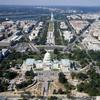
More about Washington Monument

Contributor
The Washington Monument in Washington D.C. is not the first structure to honor the OG commander-in-chief.
In fact, it wasn’t even the first obelisk Robert Mills constructed to honor George Washington. Yet, by the early 1800s American citizens felt the U.S. still didn’t have that finishing touch: the world's tallest building, a title we desperately desired, to be sure.
It’s not like this was anything new. Near unanimous support had been consistently given to the idea Washington deserved to be memorialized in some gaudy (and suspiciously girthy) fashion with one concept including a pyramid to house his corpse. It wasn’t until 1833 when a group of rich private citizens with a lot of money and time on their hands grouped together and formed the Washington National Monument Society. Their self-described purpose was to raise money, select a design for their new dream monument, and create the patriotic phallus Washington would have wanted.
However, Mills’ winning design envisioned a much crazier structure than what stands today. The selected design called for a pantheon with thirty columns containing statues of Declaration of Independence signers, a large chariot commanded by Washington above the entrance, and a six hundred foot Egyptian-style obelisk erected from the center. This concept was remarkably ambitious for the time, but outrageously expensive. Despite technological limitations, the funding of a fifth-grade art project, and what I can only imagine was an annoying amount of dick jokes, construction commenced on July 4th, 1848.
Six years and a one hundred and fifty feet later, money started depleting faster than you could say, “everyone in the universe saw this coming." Beyond finances, a more devastating series of events would halt the construction of the monument entirely. The society was overpowered by the growing influence of the Know-Nothing Party which drove away donors, Mills came down with an unfortunate case of death, and - oh yeah - the Civil War. It would take an additional sixteen years before work resumed on the monument.
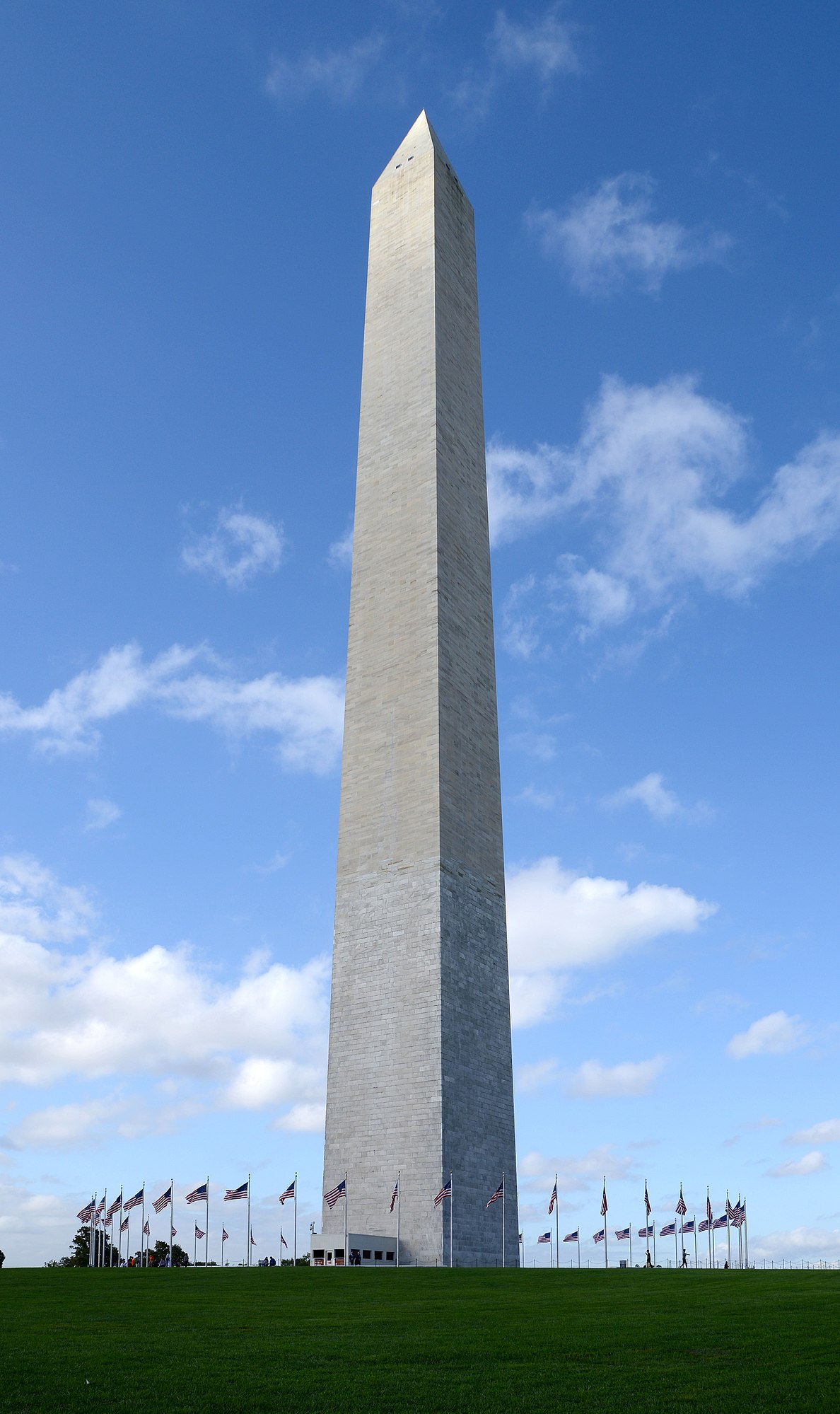
In 1876, work began again but the design was reexamined. Realizing how insane (but characteristically American) the original plan was, the U.S. Army Corps of Engineers led by Lt. Col. Thomas Casey decided to remove the pantheon entirely, shorten the obelisk to a measly five hundred and fifty-five feet and widened the base. With Casey’s newfound focus on girth over length, the only remaining issue was the Baltimore-based quarry used to supply the stone for the first one hundred and fifty feet was no longer viable. In order to get enough materials to finish the monument, builders sourced stone from quarries in Tennessee and Massachusetts resulting in a striking difference of stone color about one-third of the way up the side of the Washington Monument.
After all the setbacks, funding issues, and wars which prevented construction, the tenacious project was dedicated in 1885. This included a fancy aluminum tip and a certification as the world’s tallest building (until the Eiffel Tower was completed in 1889). In the decades following, the Washington Monument has experienced four separate restoration projects, one major earthquake, and is currently having a modern elevator installed, set for completion in 2019. It may not have been the first obelisk for Washington, but at this rate, it very well may be the last.

Featured Content
Here is what Wikipedia says about Washington Monument
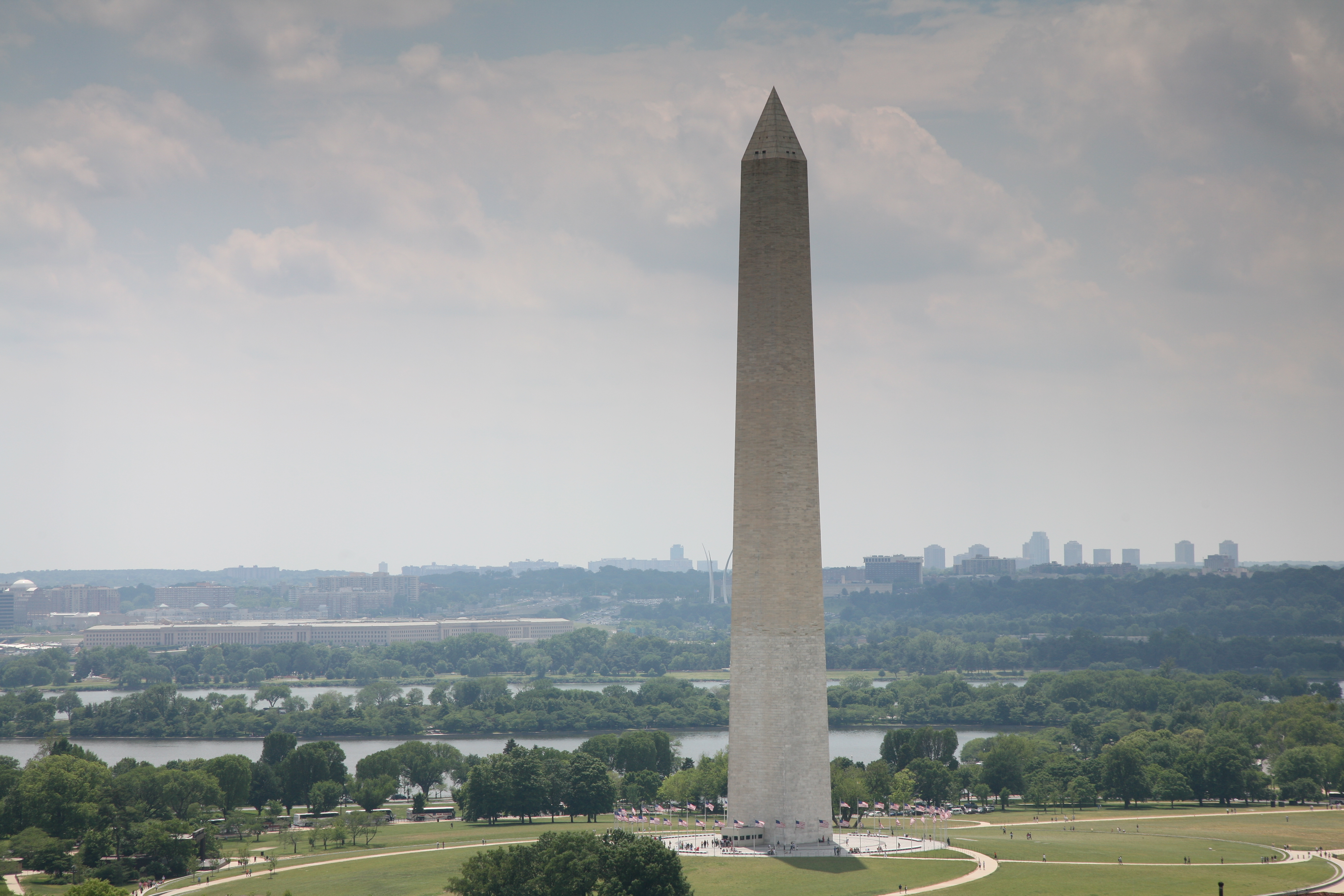
The Washington Monument is a 555-foot (169 m) tall obelisk on the National Mall in Washington, D.C., built to commemorate George Washington, a Founding Father of the United States and the nation's first president. Standing east of the Reflecting Pool and the Lincoln Memorial, the monument is made of bluestone gneiss for the foundation and of granite for the construction. The outside facing consists of three different kinds of white marble, as the building process was repeatedly interrupted. The monument stands
554 feet 7+11⁄32 inches (169.046 m) tall, according to U.S. National Geodetic Survey measurements in 2013 and 2014. It is the third tallest monumental column in the world, trailing only the Juche Tower in Pyongyang, and the San Jacinto Monument in Houston, Texas. It was the world's tallest structure between 1884 and 1889, after which it was overtaken by the Eiffel Tower, in Paris.
Construction of the presidential memorial began in 1848. The construction was suspended from 1854 to 1877 due to funding challenges, a struggle for control over the Washington National Monument Society, and the American Civil War. The stone structure was completed in 1884, and the internal ironwork, the knoll, and installation of memorial stones was completed in 1888. The original design was by Robert Mills from South Carolina, but construction omitted his proposed colonnade for lack of funds, and construction proceeded instead with a bare obelisk. The completed monument was dedicated on February 21, 1885, and opened to the public on October 9, 1888. In 2001, a temporary security screening facility was added to the entrance. Following the 2011 Virginia earthquake, the monument was closed for repairs until 2014, and it was closed again from 2016 to 2019.
The Washington Monument is a hollow Egyptian-style stone obelisk with a 500-foot-tall (152.4 m) column surmounted by a 55-foot-tall (16.8 m) pyramidion. The walls taper as they rise and are supported by six arches; the top of the pyramidion is a large, marble capstone with a small aluminum pyramid at its apex, with inscriptions on all four sides. The interior is occupied by iron stairs that spiral up the walls, with an elevator in the center. The pyramidion has eight observation windows and eight red aircraft warning lights, two per side. At the northeast corner of the foundation is a marble cornerstone, including a zinc case filled with memorabilia. Fifty U.S. flags fly on a large circle of poles centered on the monument, representing each U.S. state.
Check out the full Wikipedia article about Washington Monument