More about Utagawa Hiroshige
- All
- Info
- Shop
Works by Utagawa Hiroshige

Contributor
Utagawa Hiroshige became an artist because Japan wasn’t on fire enough.
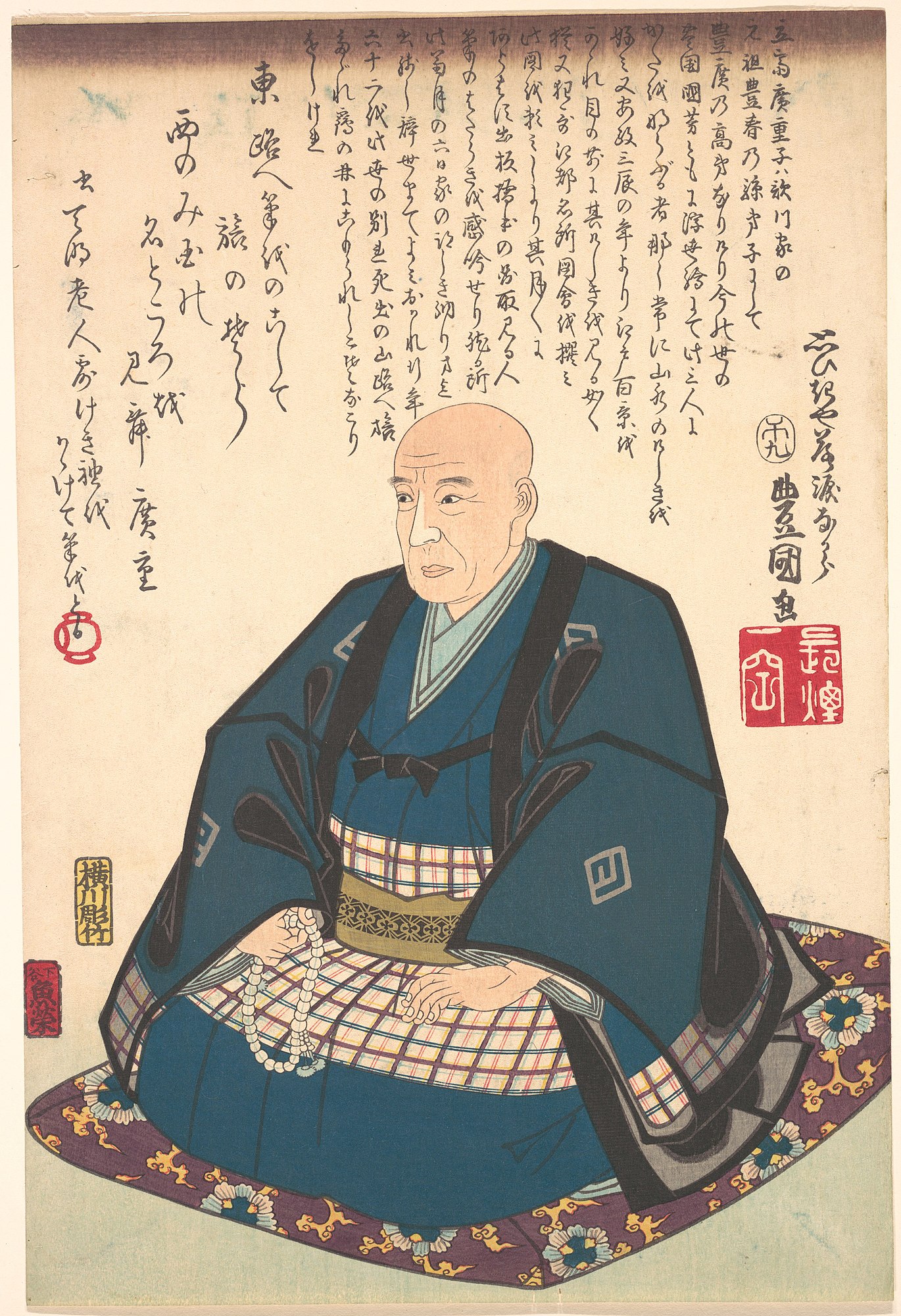
Hiroshige was born to a Japanese samurai family at Edo Castle, near modern-day Tokyo. By age twelve, he ran the Edo equivalent of the fire department. Perhaps being a tiny island in the middle of the ocean, Japan wasn’t on fire much in the early 19th century. “Fire-police” like Hiroshige had a lot of time on their hands and took up painting, gambling, crafts, cheerful (and shockingly vulgar) poetry, and other light amusements out of sheer boredom. Turned out, Hiroshige had quite a flair for painting. He entered art school at the age of fourteen, and had fully passed off his fire responsibilities to his brother by twenty-six. In pursuit of his interest in capturing landscape, Hiroshige took to the open road to see Japan’s natural scenery with his own eyes.
Although his prints are highly influential in art history, we don’t know much about the details of Hiroshige’s journey. Even his name is a little iffy; Japanese artists traditionally took their teacher’s names, so he’s also been called Ando, Juemon, Tokube, Tetsuzo, and Tokutaro before. Eventually, he settled on Hiroshige as his official “art name”. When he opened his own teaching studio, his students adopted the names Hiroshige II and III. Drama alert: Hiroshige II married the OG Hiroshige’s daughter Otatsu, and the two had a deeply troubling relationship. They eventually separated, and Otatsu later remarried none other than Hiroshige III. The love-triangle gossip unfortunately wasn’t super well-documented, but we might infer that this particular studio had some weird vibes.
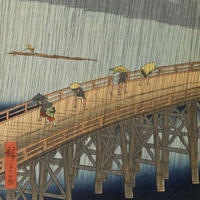
Throughout his career, Hiroshige struggled to make ends meet. Sketching specific landscapes required lengthy, expensive trips all over Japan, and his prints sold on the side of the road for about the price of a bowl of noodle soup. His wife sold her own clothing and ornate hair combs to support his craft. The upside of his prints’ cheap distribution, however, was that they circulated widely and quickly via Japan’s trade routes. Over 25,000 reproductions of 8,000 distinct images made their way into the hands and homes of the Japanese population, and his beautiful renderings of seasonal landscapes were massively popular. Once the warden of Edo fires, he soon became known as the “artist of rain, snow, and mist.”
Hiroshige’s influence extended far beyond the Land of the Rising Sun. Big-shot modern masters in Europe, including Gauguin, Degas, Monet, and especially Van Gogh had a major thing for Japan; all admired the flat shapes and schematic lines of traditional works, and Monet filled his house with over 200 Edo-style woodcuts. Van Gogh painted several copies of Hiroshige’s compositions and framed the borders in “Japanese characters.” They’re mostly made-up gibberish, but he thought they looked pretty rad. "I envy the enormous clarity that pervades their work," he wrote of Japanese printmakers. "They draw a figure with a few well-chosen lines as if it were as effortless as buttoning up one's waistcoat."
In 1856, Hiroshige “retired from the world” and became a Buddhist monk for the rest of his life. Just before he died, he left a note: "I leave my brush in the East / And set forth on my journey / I shall see the famous places in the Western Land."
Sources
Sources
- Chiappa, J. Noel. "Utagawa Hiroshige (1797-1858)." Accessed October 21, 2017. http://mercury.lcs.mit.edu/~jnc/prints/hiroshige.html.
- "Hiroshige." Wikipedia. October 18, 2017. Accessed October 21, 2017. https://en.wikipedia.org/wiki/Hiroshige.
- Sooke, Alastair. "Hiroshige: Master printmaker still making waves." The Telegraph. November 17, 2007. Accessed October 21, 2017. http://www.telegraph.co.uk/culture/art/3669308/Hiroshige-Master-printma….
- Strange, Edward F. "Ando Hiroshige." The Colour-Prints of Hiroshige. Accessed October 21, 2017. http://www.hiroshige.org.uk/hiroshige/strange/chapter_02.htm.