More about Milwaukee Art Museum
Works at Milwaukee Art Museum



Contributor
The Milwaukee Art Museum, or MAM, holds one of the world's biggest Georgia O'Keeffe collections, along with works by Frank Lloyd Wright, Gabriele Münter, and Andy Warhol.
It's also got a very sweet building, or three, actually. The MAM, Milwaukee's first art gallery, started with the donated collection of the Scottish-born politician Alexander Mitchell.
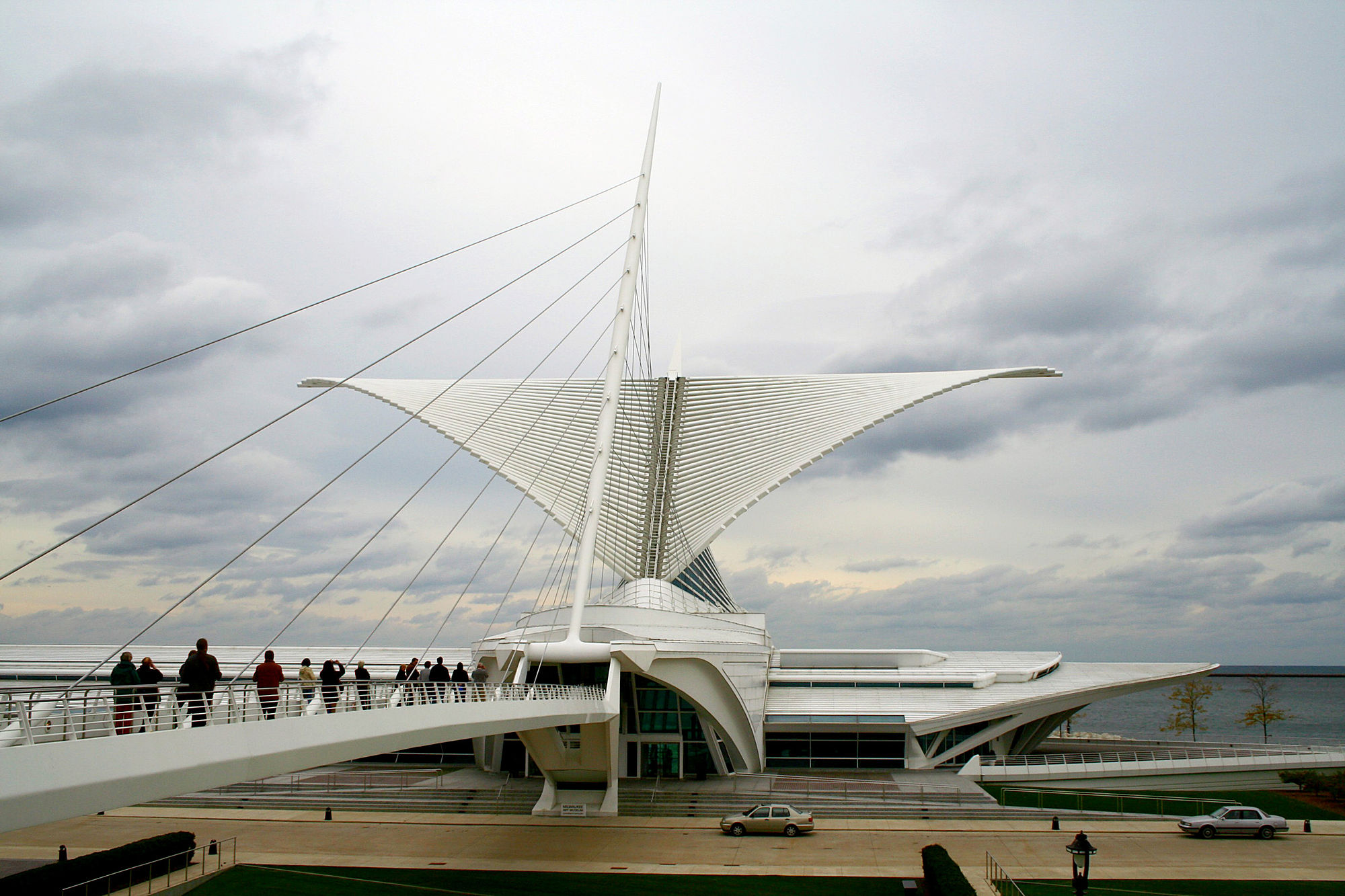
The Spanish Architect Santiago Calatrava, whose surname is a very old one associated with knights and nobles, is to architecture what Guns n' Roses was to pop music: attention-grabbing and spectacular, a household name. Calatrava's gleaming white Quadracci Pavilion was his first Stateside work and the Museum's third building, adding 13,200 square meters to the already-existing 14,900. It took seven years for Calatrava's team to build it. Within the last three years of the project, the cost ballooned from $38 to $122 million, but project manager Chris Smocke says it was an "absolute bargain," which is true when you consider that Calatrava's fee was only $3 million. His later works have cost much more, and presented more jams and glitches in their moving parts. Local architect David Kahler took home $6.7 million for his work on the project, making Calatrava look relatively abstinent. Repaying the $25 million debt left the Museum with an annual deficit of $3.6 million in the 2011-2012 year and $4.6 million in the 2010-2011 year. Still, local writer Bruce Murphy writes, "the addition has been a big hit with tourists. The project put Milwaukee on the world map in a new way, and was perhaps the first step in this city beginning to overcome its reputation as a dreary casualty of the Rust Belt." Everybody calls it "the Calatrava."
When he addressed the project in a speech nineteen years ago, Calatrava felt that he needed to balance out his flashy image with a gesture of humility, so as not to steal the show too much—"I hope," he said, "that we have designed not a building, but a part of the city." The Quadracci's "crown," according to Calatrava, is its hypnotic "Burke Brise Soleil," a movable roof with a 70-meter wingspan that faces Lake Michigan and opens every sixty minutes during visiting hours. Calatrava says, "In the crowning element of the brise-soleil, the shape of the building is at once formal (completing the composition), functional (controlling the light level), symbolic (offering an open gesture to welcome visitors), and iconic (creating a memorable image for the Museum and the city)." Before the Museum constructed its third building, the only public entrance was located in its first building, designed by Finnish architect Eero Saarinen. The Quadracci upgraded the number of entrances to three.
It's not clear how, exactly, the building was not going to stand out, gliding like a child of the Sydney Opera House over the edge of the lake. The rib-like ridges of the corridors of the temporary exhibition hall are like a white version of Gaudi's Casa Batlló in Barcelona, and they make you feel like Jonah inside the whale, relegating the art to play second fiddle.
Calatrava doesn't give many interviews, but he recently did one in order to claim that his name is being slandered by a group of political operatives who wanted him to support them for electoral office. The criticism of his work is all politics, he tells José Antonio Hernández of El País, who shoots back a rapid-fire volley of criticisms. When Hernández asks why the roof of Calatrava's Palacio de Congresos de Oviedo is jammed, the architect directs our attention, again, to the good ol' movable winged crown of the MAM, "a symbol of the city's modernity."
Sources
Sources
- Ballestros, Esther. "SANTIAGO CALATRAVA, TANTOS PROYECTOS COMO LITIGIOS JUDICIALES." Vanity Fair, Jul. 7, 2017, https://www.revistavanityfair.es/poder/articulos/santiago-calatrava-arq….
- Conrad, Howard Lewis. History of Milwaukee County: From Its First Settlement to the Year 1895, Volume 2. Milwaukee, WI: American Biographical Publishing Company, 1895.
- Hernández, José Antonio. "Santiago Calatrava: 'Hay una campaña de descrédito contra mí con fines electorales.'" El País, Oct. 28, 2014, https://elpais.com/cultura/2014/10/27/actualidad/1414434262_111252.amp….
- Hernández, José Miguel Hernández. "Milwaukee Art Museum, Wisconsin, USA, 1994 — 2001." Jun. 2011, https://www.jmhdezhdez.com/2011/06/milwaukee-art-museum-calatrava-mam.h….
- "Milwaukee Art Museum (MAM)." Calatrava, https://calatrava.com/projects/milwaukee-art-museum.html.
- Murphy, Bruce. "The High Cost of Calatrava." Urban Milwaukee, Oct. 1, 2013, https://urbanmilwaukee.com/2013/10/01/murphys-law-the-high-cost-of-cala….
- "Santiago Calatrava." Milwaukee Art Museum, https://mam.org/info/details/calatrava.php.

Featured Content
Here is what Wikipedia says about Milwaukee Art Museum
The Milwaukee Art Museum (also referred to as MAM) is an art museum in Milwaukee, Wisconsin. Its collection of nearly 35,000 works of art and gallery spaces totaling 150,000 sq. ft. (13,900 m²) make it the largest art museum in the state of Wisconsin and one of the largest art museums in the United States.
The Milwaukee Art Museum emerged from the reunion of two prior art institutions, the Layton Art Gallery and the Milwaukee Art Institute, both established in 1888. In 1957, they combined their collections inside the newly-completed Milwaukee County War Memorial designed by Finnish-American architect Eero Saarinen, forming the Milwaukee Arts Center (renamed Milwaukee Art Museum in 1980). Subsequent expansions included the David Kahler Building in 1975, the Quadracci Pavilion by Spanish architect Santiago Calatrava, inaugurated in 2001, and the East End entrance, opened in 2015.
Among highlights of the collection are paintings by American artists of the Ashcan School, American and European decorative arts, 19th-century German art and early-20th-century German Expressionist art, as well as folk and Haitian art. The museum also holds one of the largest collections of works by Wisconsin-born artist Georgia O'Keeffe in the United States.
In 2024, the Milwaukee Art Museum was ranked 8th best art museum in the country by the readers and editors of USA Today, one of the biggest US newspapers by number of subscribers and print circulation.
Check out the full Wikipedia article about Milwaukee Art Museum