More about Liverpool Quay by Moonlight

Contributor
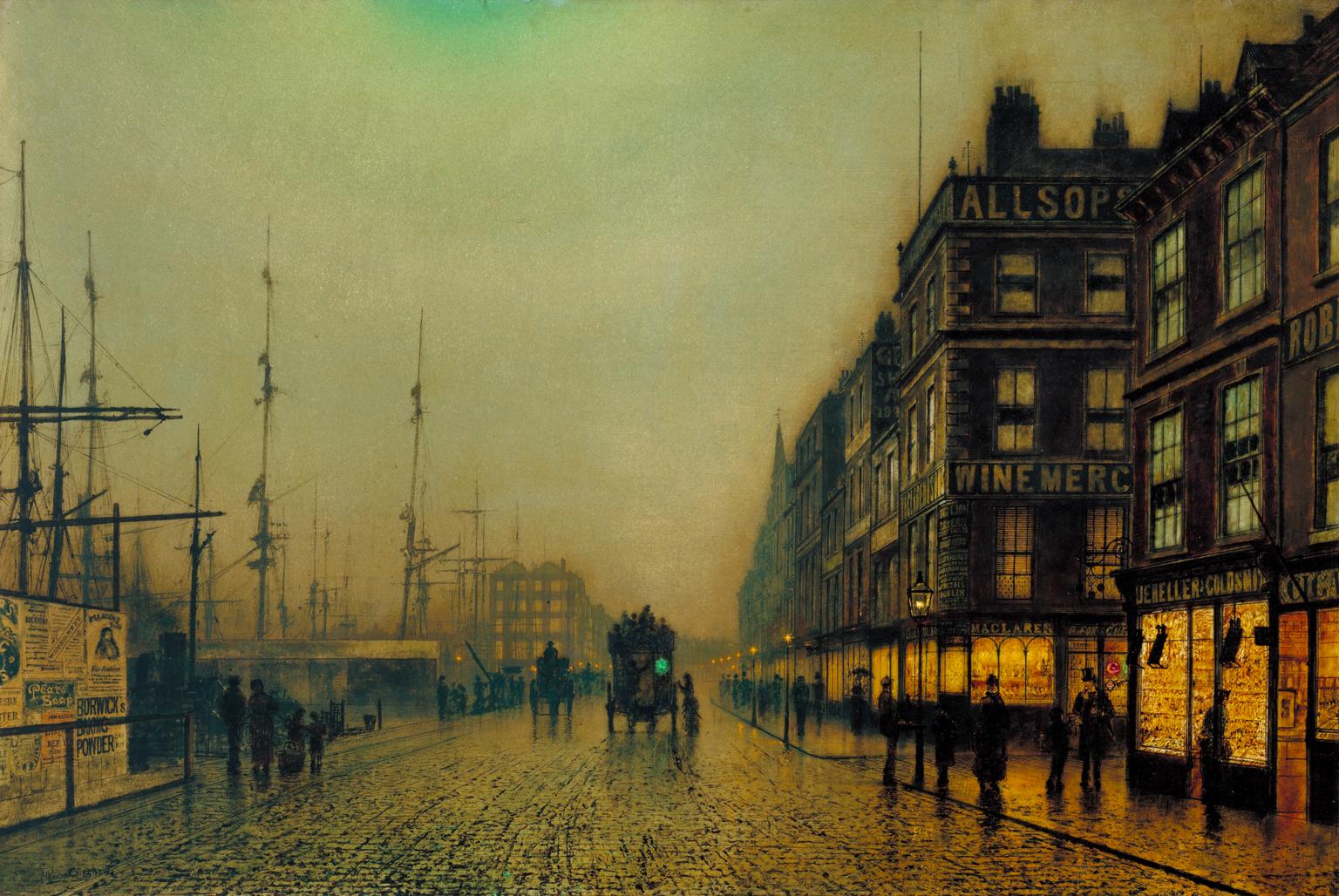
In the self-taught artist John Atkinson Grimshaw's Liverpool Quay by Moonlight, the opacity of the moon above the scene gives an ethereal glow to the shop-fronts.
The Romantic era was one of "fascination" with the atmosphere of moonlight, as evidenced in the work of Chopin, Beethoven, and Goethe. One of the most famous painters of nocturnes (night scenes) was a friend of Grimshaw's, James Abbott McNeill Whistler. Whistler said, "I considered myself the inventor of nocturnes until I saw Grimmy's moonlight picture." At the time, eastern philosophies that featured lunar calendars and central focus on the moon, were just beginning to arise in the consciousness of the British.
While it is, of course, true that Grimshaw and Whistler may have been "the most sophisticated interpreters and observers of light effects" in their era, it is not necessary to reduce their work to its effects, just as filmmakers would not want us to reduce their works to notable special effects. The work's poetic way of telling a story bolsters its effects, not the other way around.
In dialogue with the filmmaker Manthia Diawara, the Caribbean poet Edouard Glissant expounded the idea that, contrary to the monopolistic view of Plato, in which the poets and musicians, banned from the Republic, tend to arouse the passions and lead people astray from lives of piety and righteousness, poetry is the ultimate mode of communication in words: therefore, philosophers, pundits, journalists, novelists and critics all search for the poetic idiom to ground a moment. In the case of Liverpool Quay by Moonlight, Glissant's thesis is especially potent, given the fact that references to a poem about the painting by a living poet, Clive Wilmer, rise to the top of a search for information on the painting. Wilmer has, in this sense, done the greatest justice to the memory of both Grimshaw and his family, who, until recently, were the only sources of information on the painter, by commemorating his vision by means of his poetry.
Wilmer writes,
Riding at anchor ships from the New World,
Cargo-less now, away, as in a trance:
Their lights float on a mist, their sails are furled;
They have disembarked both energy and distance.
Sources
Sources
- Blühm, Andreas, and Louise Lippincott. Light!: The Industrial Age 1750-1900, Art & Science, Technology & Society. London: Thames & Hudson, 2001.
- Bolton, Roy. Russia & Europe in the Nineteenth Century. London: Sphinx Fine Art, 2008.
- Hollander, Anne. Moving Pictures. New York: Knopf, 1989.
- Littack 3. Essex: Ember Press, 1975.
- McCaw, Neil. How to Read Texts: A Student Guide to Critical Approaches and Skills. London: A&C Black, 2013.
- Robertson, Alexander. Atkinson Grimshaw. London: Phaidon, 1996.

Featured Content
Here is what Wikipedia says about Liverpool Quay by Moonlight
Liverpool Quay by Moonlight is an 1887 oil painting by the British artist John Atkinson Grimshaw. It is a cityscape that features an evening view of the city waterfront of Liverpool, then in Lancashire. An omnibus with a rear green light has stopped on the damp cobbles to pick up a woman in front of illuminated shop windows. Grimshaw became renowned for his use of light in his depictions of city scenes, inspired initially by the Pre-Raphaelites and later by James McNeill Whistler. Today the painting is in the collection of the Tate Britain in London, having been purchased in 1967.
Check out the full Wikipedia article about Liverpool Quay by Moonlight