More about Joaquín Torres-García
Works by Joaquín Torres-García

Contributor
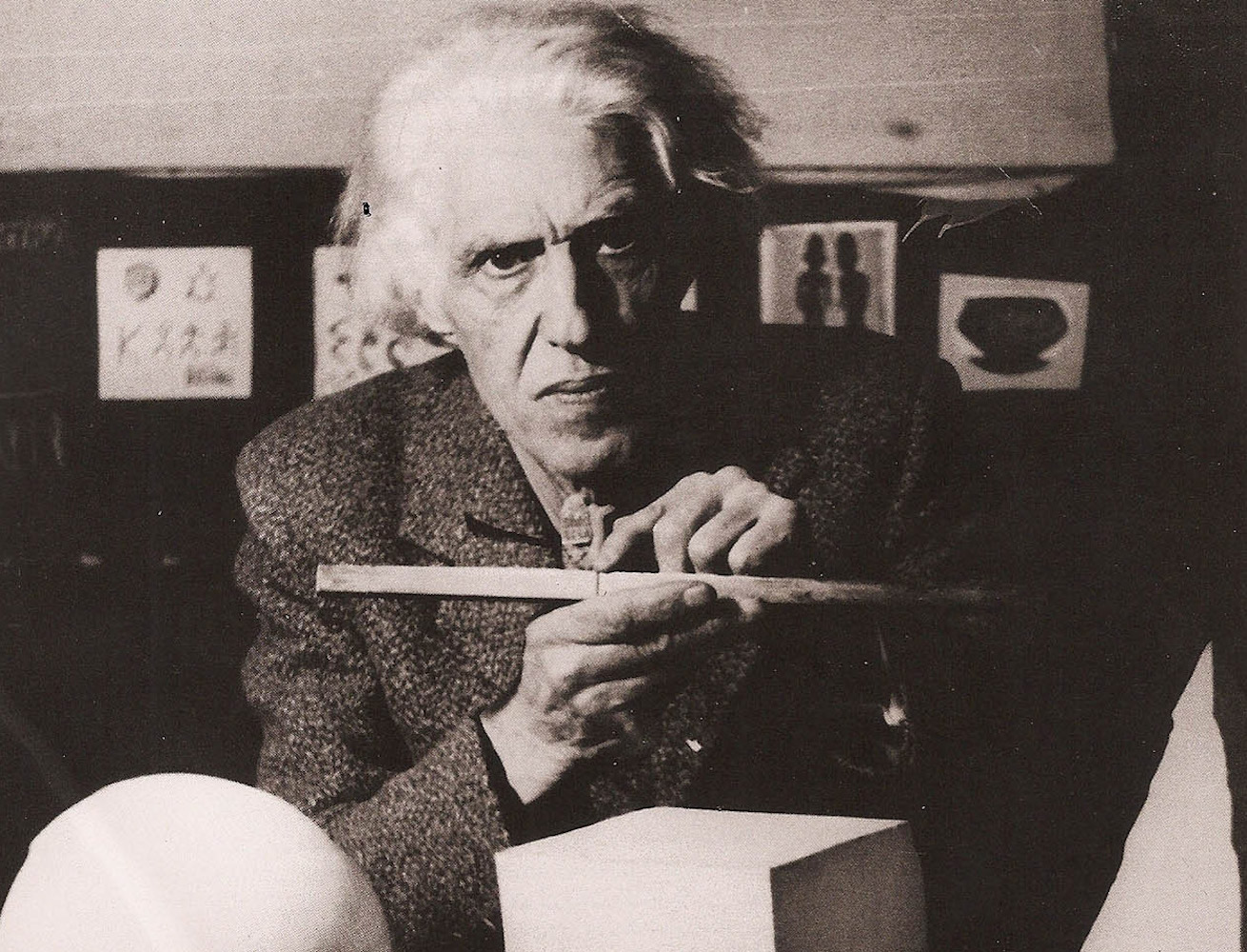
Joaquín Torres-García spent his life half chasing money, half chasing concepts; both of which are slippery buggers.
Torres-García appears to have inherited this double-quest from daddy-o, who dragged his kids halfway around the world to escape his debts (actually it’s more like ¼ of the way around from Montevideo to Barcelona but you get what I mean).
Joaquin bopped around the Northern hemisphere for 42 years, halfheartedly pursuing each portion of his two-headed mission. In his desire to make bank he started an art school for mural painting in Spain and a toy manufacturing business in Italy, both failed; he tutored students in drawing until marrying one student’s daughter; and took commissions from Anton Gaudi (looks great on résumés).
He simultaneously chased concepts around like a chicken with its head cut off. He dabbled in Catalan nationalism for a while until it developed an authoritarian tone, which was all the rage in the early 20th century. He exhibited with Société Anonyme in New York City and Cercle et Carré in Paris, he gave some lectures in Madrid, but kept getting bored with superficial styles and unresponsive students (hungover? on dope? kids these days...) and moving on to the next thing.
Eventually he returned to Montevideo where he declared Europe and colonialism officially dead, “If [writers, painters, or composers] didn’t learn the lessons of Europe when they should have done, too bad for them because the moment has passed.” Joaquin determined that the whole northern hemisphere was passé, he famously inverted the map of South America, hollered out “Our North is the South!” and flipped the bird to the European modernism with which he had come of age.
Having finally completed the concept half of his life’s journey with his discovery of “post-europe” he spent the rest of his life writing books about how great art was before that jerk Chris Columbus showed up and copying ancient symbols on stone plates and canvas. This tradition has survived three generations and will probably continue as long as MoMA continues to insist that TorresGarcía is the only Latin American artist that has ever existed.
Sources
Sources
- Ades, Dawn, Guy Brett. Art in Latin America: The Modern Era, 1820-1980. New Haven: Yale University Press, 1989. 144. Accessed June 6, 2017. https://books.google .com/books?id=lT84yyDd_uMC&pg=PA144&lpg=PA144&dq=cosmic+monument+torres+garcia&source=bl&ots=g
- Art and Antiques Magazine. November 2014. “Latin American Original.” Art & Antiques Magazine. Accessed June 6, 2017. http://www.artandantiquesmag.com /2014/11/joaquin-torres-garcia-art/
- The Editors of Encyclopeadia Britannica. “Joaquin Torres-Garcia: Uruguayan Painter.” Encyclopeadia Britannica. Accessed June 6, 2017. https://www.britannica.com /biography/Joaquin-Torres-Garcia
- Jiménez, Maya. “Torres García, Inverted America.” Khan Academy. Accessed June 6, 2017. https://www.khanacademy.org/humanities/global-culture/identity-body/ide…
- Rank, Anna. “Torres García and the Pre-Columbian Art.” Arte Mercusor. Accessed June 6, 2017. http://www.artemercosur.org.uy/artistas/torres/pre.html
- The Solomon R. Guggenheim Foundation. 2017. “Joaquín Torres García.” Guggenheim: Collection Online. Accessed June 6, 2017. https://www.guggenheim.org/artwork/artist/ joaquin-torres-garcia

Featured Content
Here is what Wikipedia says about Joaquín Torres-García
Joaquín Torres-García (28 July 1874 – 8 August 1949) was a Spanish Uruguayan painter, theorist, teacher and author, who spent most of his adult life in Spain. Later, traveled and lived in the United States, Italy, France, and Uruguay. One of the most influential artists of the 20th century, he is known for founding influential schools and groups, including the Escola de Decoració (School of Decoration) in Barcelona; Cercle et Carré (Circle and Square) in Paris—the first European abstract-art group, which brought together artists such as Piet Mondrian and Wassily Kandinsky; the Grupo de Arte Constructivo (Constructive Art Group) in Madrid; and the Taller Torres-García (Torres-García's Workshop) in Montevideo.
In his paintings Torres-García developed a pictorial language, that was a synthesis between representation and abstraction. His pictograms, figures reduced to signs that function like a written language, were embedded within a geometric composition. His structural principles were rooted in classical traditions derived from Greek and Roman culture; he experienced in Catalonia during his youth—He first referred to it as Modern Classicism, later evolving it into what became known as Universal Constructivism. At its core was his conviction that geometry constitutes a universal visual language, shared instinctively across cultures and eras.
Check out the full Wikipedia article about Joaquín Torres-García