More about Young Hare
- All
- Info
- Shop

Contributor
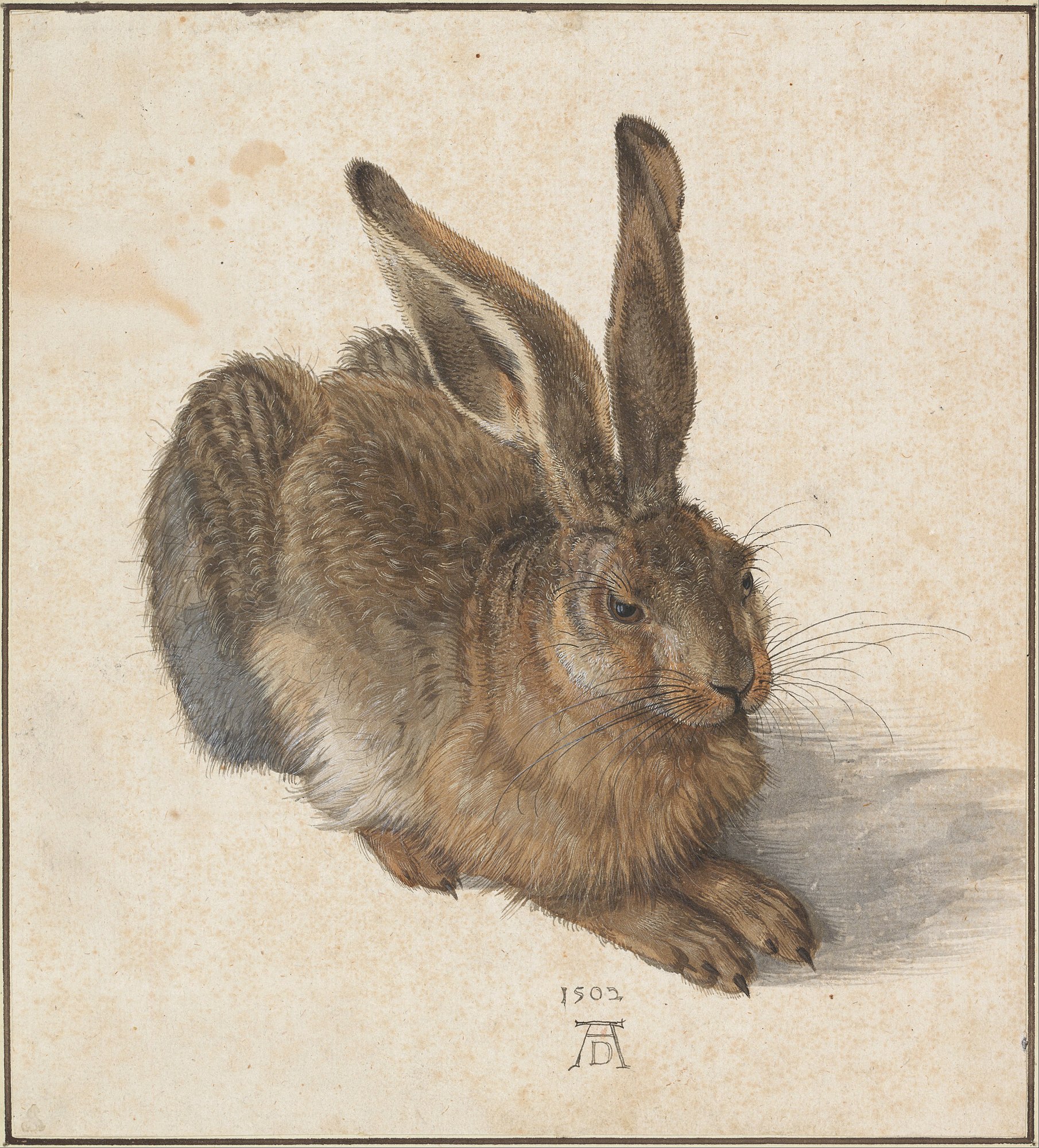
The (alleged) young hare didn't have to lie about his age to get in front of Albrecht Durer.
The German artist could have cared less, he just called him a field hare. The hare was looking for his big break, so what if he was a few years older than he’d told them. Everyone in Hollywood does it. The hare just wanted Durer to paint him like one of his German girls.
Durer finished this watercolor of the little guy in 1502. At the time, animals weren’t usually painted with so much care. Durer’s execution was meticulous; this kind of photorealism was heretofore unheard of. You can even see the studio window in the bunny’s eyes. He could’ve been burned at the stake for this sorcery. Thankfully, the world just hailed him as the genius that he was instead. The painting got so popular that at least twelve of Durer’s contemporaries decided to have a go at the adorable bunny.
No one can say for sure how Durer came to meet this furball, but if you’re looking for a story I could give you one. A popular legend has it that Durer was walking in the woods. It was probably an afternoon stroll or such. He came across the little hare and saw that it was injured. Durer, the compassionate guy that he was, took the bunny back to the studio. I’m hoping he wasn’t planning on stuffing him.
Viewing this painting is a little bit of a delicate matter. The paper and paint are so sensitive that the Young Hare cannot be permanently displayed. The Albertina fishes the painting out once every few years. It’s like a comet that appears only in Vienna. In 2016, the painting was brought to the public for all of seven hours. That’s how long it would take me to get to Vienna from Bombay. Imagine missing the Young Hare in the commute. I’d be devastated, though not as much as the Albertina would be if they destroyed the painting. I can always catch a flight again, Durer’s chances of coming back from the dead are close to zero.
Sources
Sources
- jimmyneutron2011. “Art Admiration.” Art Admiration (blog). Wordpress, November 26, 2017. https://artadmiration.wordpress.com/2017/11/26/young-hare/.
- “Young Hare by Albrecht Dürer - Facts & History of the Painting.” Totally History, April 14, 2013. http://totallyhistory.com/young-hare/.
- “Young Hare.” Artble, July 19, 2017. https://www.artble.com/artists/albrecht_durer/engravings/young_hare.
- Admin. “Description Picture.” Description picture - Durer Albrecht, January 12, 2019. https://en.opisanie-kartin.com/description-of-the-painting-by-albrecht-….
- “ Dürer's Young Hare.” Visiting Vienna, August 4, 2019. http://www.visitingvienna.com/sights/museums/durer-hare/.
- “Comeback of the Hare.” VIENNA – Now. Forever. Accessed September 30, 2019. https://www.wien.info/en/sightseeing/museums-exhibitions/albrecht-duere….

Featured Content
Here is what Wikipedia says about Young Hare
Young Hare (German: Feldhase) is a 1502 watercolour and bodycolour painting by the German artist Albrecht Dürer. Although the piece is normally given the title Young Hare, the physical characteristics of the hare identify it as a mature specimen; the German title translates as "Field Hare" and the work is sometimes referred to in English as the Hare or Wild Hare.
Painted in 1502 in his workshop in Nuremberg, Germany, it is acknowledged as a masterpiece of observational art alongside his Great Piece of Turf from the following year. The subject is rendered with almost photographic accuracy.
The work remained in Dürer's workshop until his death in 1528. The work was then sold to Willibald Imhoff, to whom it belonged until 1588, when Imhoff sold it to Emperor Rudolf II due to financial difficulties. In 1691, the work made its final move to the Albertina Museum in Vienna, where it is still held.
Check out the full Wikipedia article about Young Hare