
More about The Order of Release 1746
- All
- Info
- Shop
Contributor
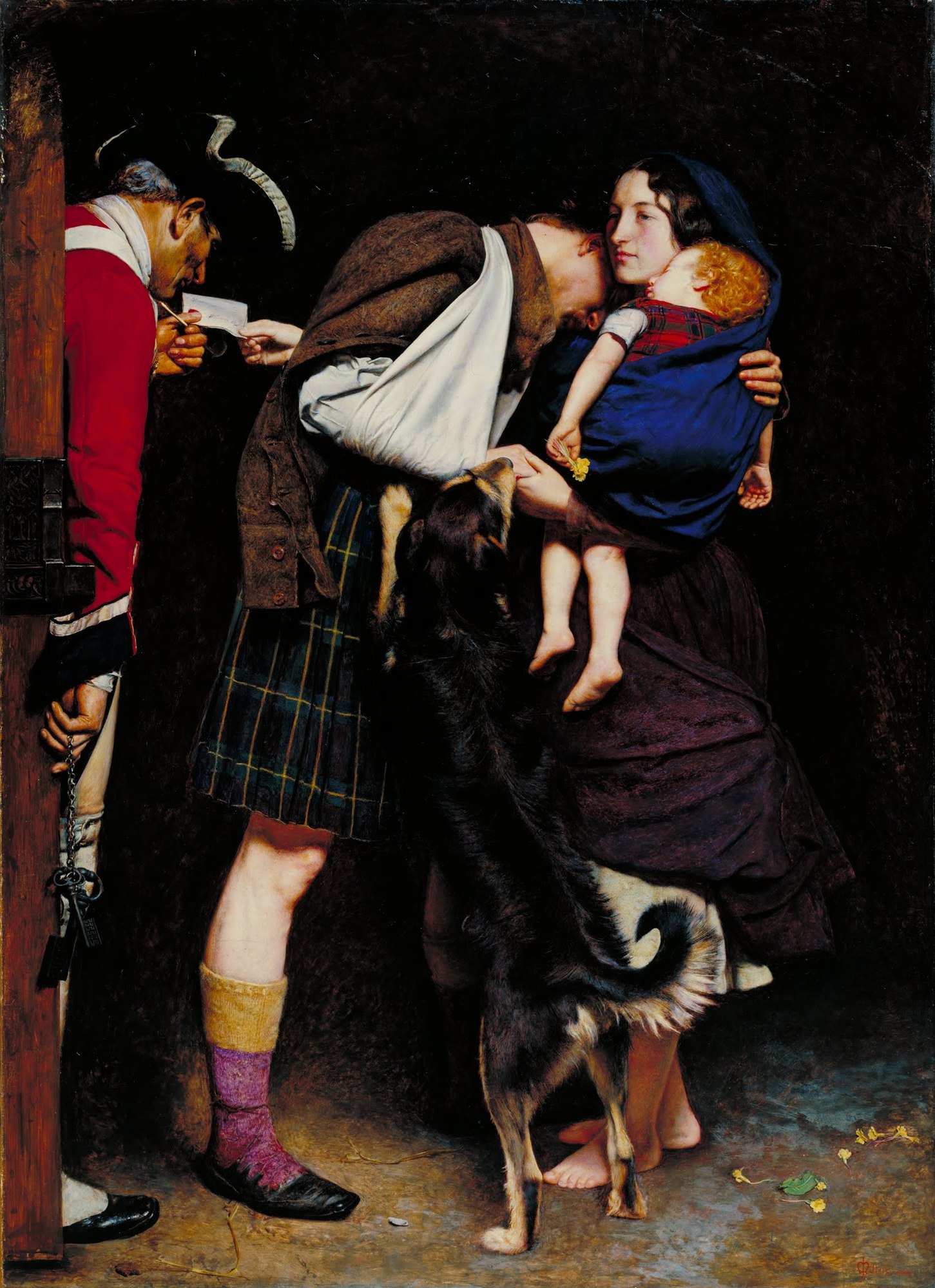
The Order of Release by John Everett Millais depicts the homecoming of a Jacobite rebel to his not so sympathetic wife in 1746.
A little bit of background: the Jacobite rebellion was an attempt to overthrow the British throne in an effort to give power back to James Francis Edward Stuart and his sons in the mid-1700s. It was spearheaded by James Francis Edward Stuart’s son, Charles Edward Stuart, also known as Bonnie Prince Charles. They made it all the way to Derby before the leaders of the rebellion decided that they should turn back, realizing that they were vastly outnumbered by the government armies. In 1746, the Jacobites' loss at the Battle of Culloden ended the entire uprising and many of the rebels were imprisoned, including this guy.
There is something a little off about this reunion though. The dog is happier to see this guy than his wife or kid. Obviously dogs are the absolute #1 best when it comes to making you feel like a hero just for coming home, but usually in a been-at-war situation the excitement levels between family and dog are at least matched. This situation is a little different. And it’s probably because the dog doesn’t know that the woman may or may not have had to compromise her virtue for the release of her husband. It’s just a theory, but by the look on the woman’s face, something about her husband’s return isn’t making her very excited. The kid is even worse. He doesn’t even wake up when his father comes home. I don’t care if he’s two years old, he’s being a jerk.
The story depicted in this painting was fictional, but may have been inspired by the writings of Sir Walter Scott. Millais made sure that every little detail, down to the tartans that the characters were wearing were accurate. At one point the painting was titled The Ransom and the woman was shown handing the man a bag of money. But then the painting was altered to show her handing him an order of release. Millais used his fiancé, Effie Ruskin as a model for the wife and a professional model named Westall for the father. The model for the kid was, according to Millais, a nightmare and a half to work with. The child “seemed so obstinate that she would not do anything I wanted, and when forced, by Westall's superior strength, squalled and foamed at the mouth.” It seems like they probably should have checked the kid for rabies, but what do I know.
This painting was a huge hit when it made it to the Royal Academy in 1853. It was purchased by the lawyer Joseph Arden for £400 but made its way into the Tate by 1898.
Sources
Sources
- Fowle, Frances. "‘The Order Of Release 1746’, Sir John Everett Millais, Bt, 1852-3 | Tate." Tate. N.p., 2000. Web. 1 Oct. 2018. https://www.tate.org.uk/art/artworks/millais-the-order-of-release-1746-…
- Ravenhill, William et al. "Charles Edward, The Young Pretender." Encyclopedia Britannica. N.p., 2017. Web. 1 Oct. 2018. https://www.britannica.com/biography/Charles-Edward-the-Young-Pretender
- "The Order Of Release 1746 - Sir John Everett Millais - Google Arts & Culture." Google Cultural Institute. Web. 1 Oct. 2018. https://artsandculture.google.com/asset/the-order-of-release-1746/cQEhu…

Featured Content
Here is what Wikipedia says about The Order of Release, 1746
The Order of Release, 1746 is an 1852–53 painting by John Everett Millais exhibited in 1853. It is notable for marking the beginnings of Millais's move away from the highly medievalist Pre-Raphaelitism of his early years. Effie Gray, who later left her husband John Ruskin for Millais, modelled for the female figure.
Check out the full Wikipedia article about The Order of Release, 1746