

More about The Banquet of Cleopatra

Contributor
Giambattista Tiepolo was a master of historical reenactments.
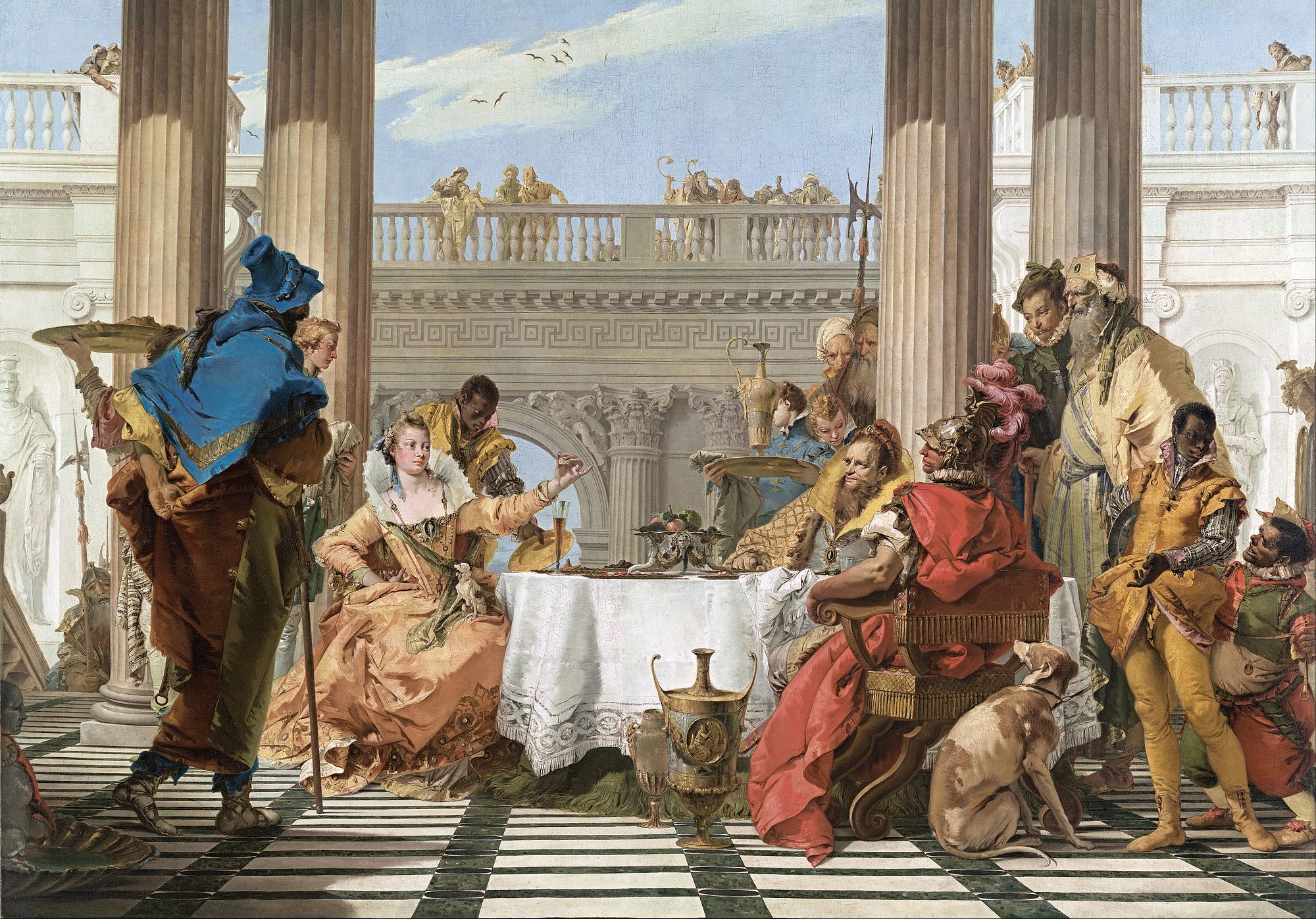
Cleopatra was a subject of fascination for Tiepolo. The Venetian master made sketches, painted frescoes and oil paintings concerning all things Cleopatra. He completed two large paintings of Cleopatra and Mark Antony dining together; one hangs at the Palazzo Labia in Venice, the other is in Melbourne, Australia; the latter is our topic of discussion today.
The Banquet of Cleopatra is Tiepolo’s depiction of the encounter in Alexandria between Cleopatra and Mark Antony once Antony returned triumphant from Parthia. While Paolo Veronese is a distinct influence on the Banquet of Cleopatra, the banquet scene was lifted from Pliny the Elder. Where dripping with jewelry fit for a royal, Cleopatra dines with Mark Antony and guests. Teasing now, she’s about to make a cocktail ludicrously expensive by dropping a pearl earring in a goblet of vinegar. I mean, Mark Antony still has his helmet on like he’s going to be called away to battle!
Tiepolo was hard at work completing the painting during the winter of 1742-1743. There are subtle differences between the Venice painting and the Melbourne painting. For one thing, the Melbourne piece is notable for Cleopatra’s apricot dress. The illustriousness and luxury of the painting extends to the frame, which is in timber and gold leaf.
The painting came about with a little help from an unlikely friend, Francesco Algarotti. In 1743, Venice born Algarotti returned to his hometown to buy old and new paintings for his boss, Augustus III, King of Poland. Tiepolo impressed Algarotti with his sick skills on the canvas, causing Algarotti to more or less swoon over the master painter. By January of 1744, after a year of building rapport and gaining a friendship with Tiepolo, Algarotti spied the unfinished Banquet of Cleopatra in Tiepolo’s studio. While this painting wasn’t on the payroll, Tiepolo was willing to finish it for the Polish King. That’s what networking does for you.
The painting reached the National Gallery of Victoria in a most ludicrous way. It’s never a good sign when the leader of a country starts selling off parts of the state for cold hard cash, but that’s exactly what Joseph Stalin did to the Hermitage collection. Apparently, Stalin sold it to the National Gallery in London for a wad of cash. The Brits on the other hand, weary of dealing with the USSR at a time when they were bad guy numro uno, undervalued this most prestigious painting and the Aussies from Melbourne scooped up this one-of-a-kind treasure. Looking back now, it seems like a bargain, but the painting was pricey for its time. At £ 25,000, it was the most expensive painting sold in 1932.
Sources
Sources
- Bagott, Francis John, The Wrightsman Collection Volume V. The Metropolitan Museum of Art, 1973.
- Barcham, William L., “Secular commissions: Tiepolo as a Painter of history and mythology and as a decorator,” Giambattista Tiepolo, 1696-1770. New York: The Metropolitan Museum of Art, 1996.
- Danto, Arthur C., “Pleasure, light, glory,” The New York Times, December 31, 2009. Accessed March 18, 2020. https://www.nytimes.com/2010/01/03/books/review/Danto-t.html
- Caleb Cluff, “The art gallery of Ballarat is selling some bequeathed furniture to improve its collection,” The Courier, January 19, 2018. Accessed March 18, 2020. https://www.thecourier.com.au/story/5172423/reassessing-a-collection-wh…
- Cox, Will, “One of the world’s best art collections is hiding in plain sight,” Broadsheet, November 26, 2018. Accessed March 18, 2020. https://www.broadsheet.com.au/national/art-and-design/article/one-world…
- Cox, Will, “The NGV is hosting a dinner party (and letting the artists set the tables),” Broadsheet, May 1, 2019. Accessed March 18, 2020. https://www.broadsheet.com.au/melbourne/food-and-drink/article/ngv-host…
- Gill, Raymond, “The finding of a Tiepolo masterpiece,” The Age, January 12, 2010. Accessed March 18, 2020. https://www.theage.com.au/national/victoria/the-finding-of-a-tiepolo-ma…
- Morcillo, Marta Garcia, “Seduced, Defeated and Forever Damned: Mark Antony in Post-Classical Imagination,” Seduction and Power: Antiquity in the Visual and Performing Arts, ed. Silke Knippschild and Marta Garcia Morcillo. London: Bloomsbury, 2013.

Featured Content
Here is what Wikipedia says about The Banquet of Cleopatra (Tiepolo)
The Banquet of Cleopatra is a painting by Giovanni Battista Tiepolo completed in 1744. It is now in the National Gallery of Victoria in Melbourne, Australia.
The subject of the painting is a supposed historical banquet, hosted by Cleopatra for Marc Antony, and described by both Pliny's Natural History (9.58.119–121) and Plutarch's Lives (Antony 25.36.1). During this banquet Cleopatra takes an expensive pearl and dissolves it in her wine, prior to imbibing the drink.
This is the first of three large paintings of the subject by Tiepolo. In addition to these, the much smaller oil studies or modelli for each of the larger paintings survive.

Tiepolo returned to the subject a few years later at the Palazzo Labia in Venice with his frescoes on the theme of Mark Antony and Cleopatra: the Banquet was paired with a Meeting of Cleopatra and Mark Antony and surrounding scenes of gods and attendants. Two further large canvases by Tiepolo of these scenes are in the Arkhangelskoye Palace near Moscow (1747; 338 × 600 cm).
Tiepolo typically made oil sketch modelli with varying degrees of finish to show his composition and, perhaps, submit it for approval to the client. The modello for the Melbourne painting is in the Musée Cognacq-Jay in Paris, and was owned by Count Francesco Algarotti until his death. There is a small (46.3 by 66.7 centimetres (18.2 in × 26.3 in)) oil sketch by Tiepolo in the National Gallery, London, which may relate to the painting in the Palazzo Labia, although it differs considerably from that work; it is more usually regarded as a study for the Archangelskoye painting. There is another small work in oils in the collection of Stockholm University in Sweden, a modello for the Palazzo Labia composition, and there are a number of preparatory drawings in various collections.
Check out the full Wikipedia article about The Banquet of Cleopatra (Tiepolo)