More about Jan van Eyck
- All
- Info
- Shop
Sr. Editor
Jan van Eyck came from a large family of talented painters, of which he was without doubt the star.
He was also so good with oil paint that a myth emerged that he'd invented it. Before this time, most artists used egg tempera instead of oil-based paint. Tempera paints dried very fast and did not allow for any translucency. That meant no special effects.
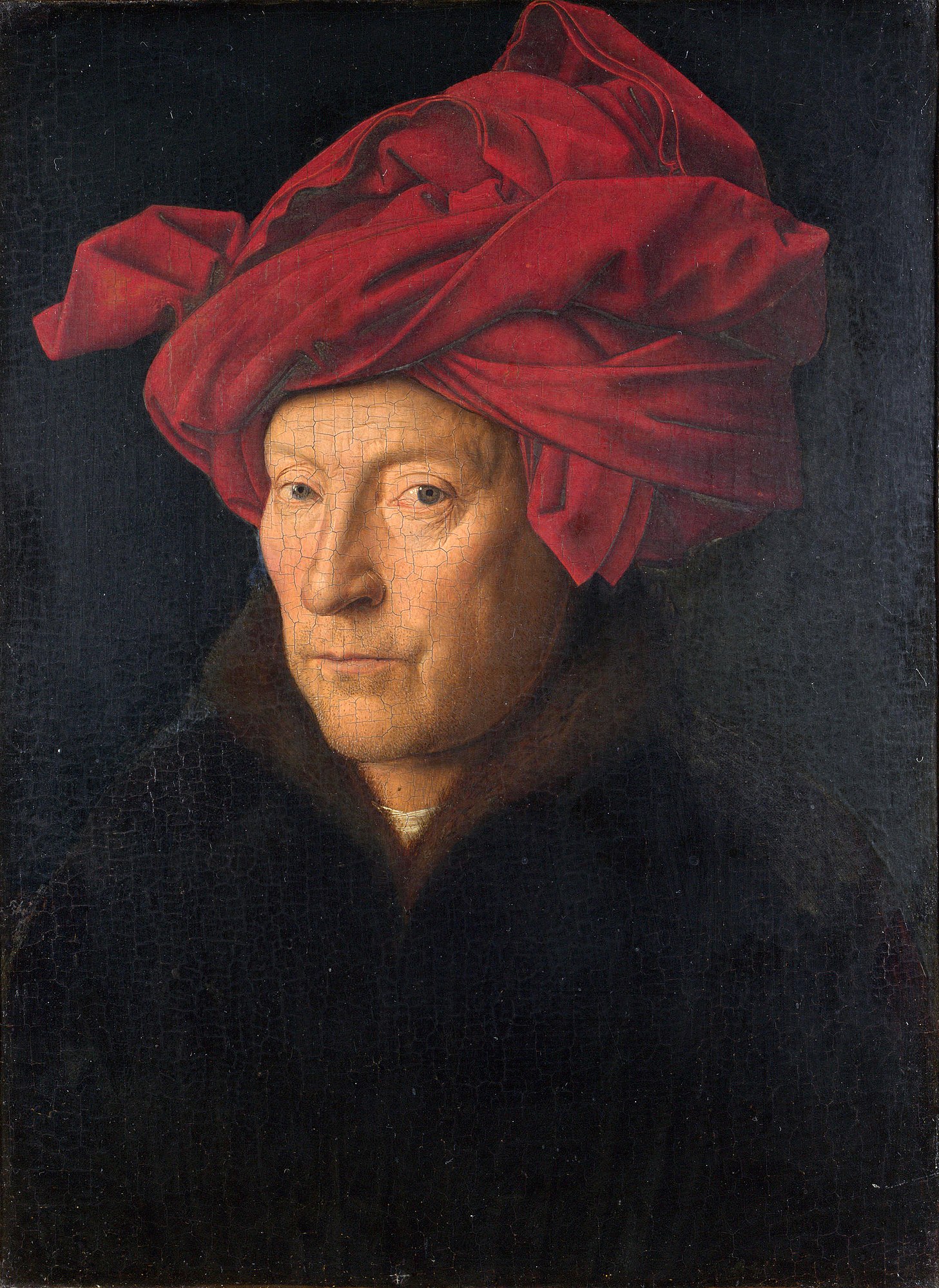
Van Eyck was a master of extreme detail. Look closely at his paintings and you will see individual hairs, sweat, and gleaming jewels. He practically invented realism. Some of his contemporaries thought he was huge cheater because he used mirrors to project the subject onto the canvas and trace it before filling in with oil paints.
As a court painter to Philip the Good, Duke of Burgundy, van Eyck made tons of money. He was one of the few wealthy artists of his time.
He was also godfather to Philip's children, a diplomat, and an all around right hand man. In addition to painting, the Duke sent him on various sometimes-secret missions as an ambassador. On one trip he went to Portugal to paint a portrait of the duke’s future bride Isabella of Portugal. They had no cameras in those days and the duke had never laid eyes on Isabella.
As Van Eyck’s reputation grew, he didn’t mind a little self-promotion. He was one of the first artists to sign and date his work. He also wrote his personal motto Als ich kan (As well as I can) on his canvases.
Van Eyck's style was super popular and so you might accidently confuse his work with other artists of the time like Rogier van der Weyden and Robert Campin.
Featured Content
Here is what Wikipedia says about Jan van Eyck

Jan van Eyck (/væn ˈaɪk/ van EYEK;
Dutch: [ˈjɑɱ vɑn ˈɛik]; c. before 1390 – 9 July 1441) was an early Netherlandish painter active in Bruges who was one of the early innovators of what became known as early Netherlandish painting, and one of the supreme figures of the Early Northern Renaissance. Such was his legacy, that he has been called "the inventor of oil-painting" by Vasari, Ernst Gombrich, and others, although this claim is now considered an oversimplification.
Surviving records date his birth at around 1380 or 1390, in Maaseik (then Maaseyck, hence his name) by the Limburg in present-day Belgium. He took employment in The Hague around 1422, when he was already a master painter with workshop assistants, and was employed as painter and valet de chambre to John III the Pitiless, ruler of the counties of Holland and Hainaut. Some time after John's death in 1425, he was appointed as court painter to Philip the Good, Duke of Burgundy, and worked in Lille before moving to Bruges in 1429, where he lived until his death. He was highly regarded by Philip, and was dispatched on several diplomatic visits abroad, including one to Lisbon in 1428 to discuss the possibility of a marriage contract between the duke and Isabella of Portugal.
About 20 surviving paintings are confidently attributed to him, as well as the Ghent Altarpiece and the illuminated miniatures of the Turin-Milan Hours, all dated between 1432 and 1439. Ten are dated and signed with a variation of his motto ALS ICH KAN (As I (Eyck) can), a pun on his name, which he typically painted in Greek characters.
Van Eyck painted both secular and religious subjects. His works include altarpieces, painted panels—diptychs (dismantled), triptychs, and polyptychs—and commissioned portraits. He was well paid by Philip, who wanted the painter to have the financial security and artistic freedom to paint "whenever he pleased." Van Eyck's early work shows influence from the International Gothic style, which he soon eclipsed, in part through a greater emphasis on naturalism and realism. He achieved a new level of virtuosity through his developments in the use of oil paint. His style and techniques profoundly altered the development of the Early Netherlandish school.
Check out the full Wikipedia article about Jan van Eyck